Crustacean
American lobster
Homarus americanus
Out of season
—
Fishing zones
Wild
Origin
9 cm
Minimum size
Description
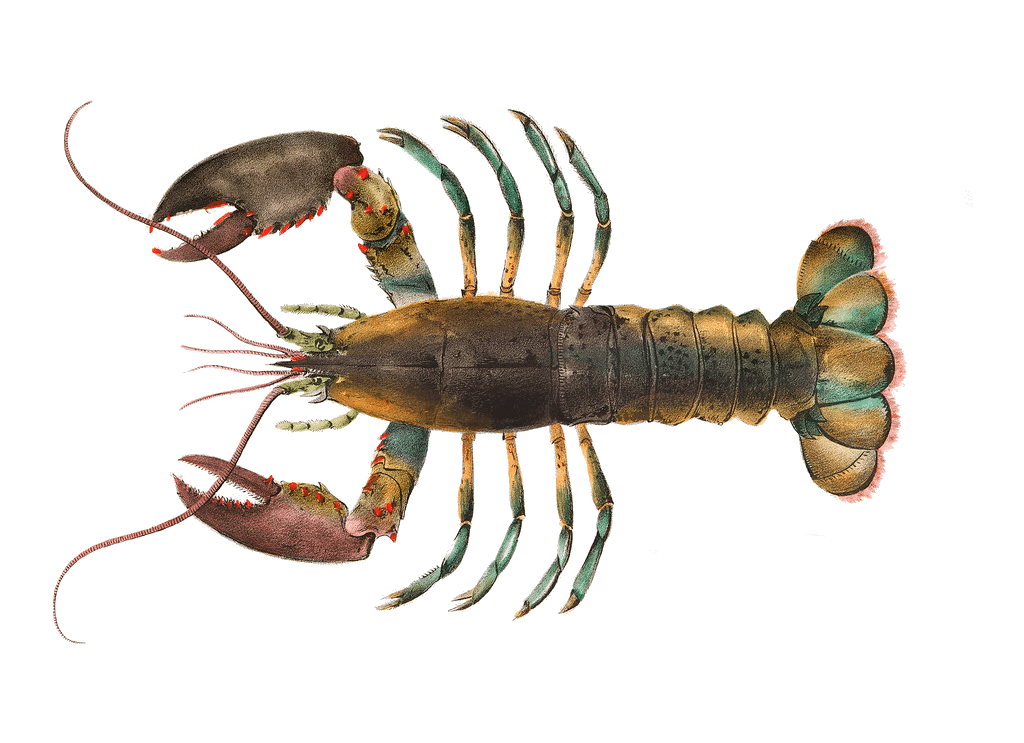
It is a large decapod crustacean with a smooth shell and two pairs of antennae. Its most striking feature is its pair of disproportionate and asymmetrical claws: the crushing claw (wider and serrated) for breaking shells, and the cutting claw (thinner and sharper) for shredding the meat. In its natural state, its color ranges from olive green to blackish brown, with orange highlights on the joints and undersides of the claws. It turns bright red only after cooking (due to the release of astaxanthin). Unlike the European lobster (Homarus gammarus), the American lobster generally has spines on the underside of the rostrum (the tip between the eyes). It is the heaviest crustacean in the world. It commonly measures 25 to 50 cm, but can reach 60 cm to 1 meter in length, with a record weight of over 20 kg.
Habitat
A benthic species found on the continental shelf. It prefers rugged seabeds that offer hiding places, such as rocks, boulders, and gravel beds. Juveniles often dig burrows in mud or compact sand. It is found from the intertidal zone down to depths of 480 meters, although it is most common between 4 and 50 meters. It is a solitary and territorial animal, primarily active at night. It feeds on fish, mollusks, other crustaceans, and occasionally carrion.
Distribution
Its range extends from Labrador (Canada) in the north to Cape Hatteras (North Carolina, USA) in the south. The densest populations are found in the Gulf of Maine, around Nova Scotia, and in the Gulf of St. Lawrence.