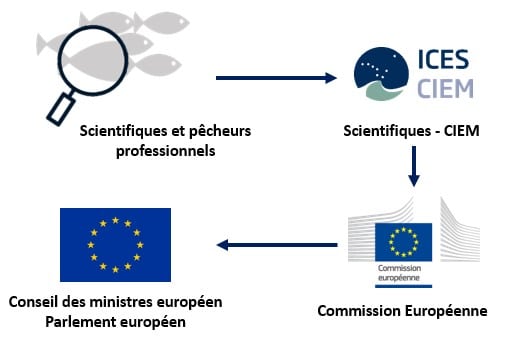
In every European country, research centers, in partnership with commercial fishermen, conduct scientific surveys to collect various data (species, size, weight, quantity, etc.) that will enable them to assess the fishery. After analyzing this data, scientists from all European Union member states issue scientific advice by species through the ICES—the International Council for the Exploration of the Sea.
This advice takes into account:
- the state of the biomass (spawning stock biomass(1), recruitment(2), etc.),
- the impact of fishing (landings and fishing pressure (3)),
- recommendations on potential future management measures.
Currently, more than 130 stocks(4) are monitored regularly in European waters.
These opinions are then reviewed by the European Commission, which will subsequently propose concrete management measures for each species. These proposals will be presented to the European Parliament and the Council of European Ministers. These two bodies will then exchange views and debate whether to approve each proposal, first within their respective bodies and then between them.
In practice, together, they each have legislative authority over proposals for new management measures. However, in the event of a dispute, the Council of European Ministers may amend, approve, or reject a measure previously decided by the Parliament. For certain issues, only one of the two is involved in the decision-making process; for example, in fisheries, only the Council approves quotas.
(1) Spawning biomass: This refers to the quantity of fish of reproductive age, i.e., those that have reached sexual maturity.
(2) Recruitment: This refers to the arrival of young fish reaching “adult” size for a specific species in a given area. These new “recruits” become exploitable for that stock.
(3) Fishing pressure: This is defined by fishing activity in a specific fishing area based on the fishing technique used (vessel size, fishing gear, etc.).
(4) Stock: This refers to the exploitable biomass of a species present in a specific area. For some species, there are several stocks depending on the area, each with its own dynamics (growth, reproduction).