On June 12, 2025, as part of the United Nations Decade of the Ocean conference, the virtual side event "Can We Still Eat Seafood? Adopting Responsible Consumption and Production of Seafood and Aquaculture to Protect Marine Biodiversity" brought together experts, innovators, and stakeholders from across the seafood value chain. Co-organized by two Horizon Europe-funded projects, Mr.Goodfish3.0 and VeriFish, both of which are part of the EU’s mission “Restoring our oceans and waters by 2030,” the event explored the essential role of informed seafood choices in safeguarding marine biodiversity and supporting resilient livelihoods for coastal communities.
Navigating a Complex Value Chain
As marine ecosystems face increasing pressure and public interest in sustainable diets grows, the webinar highlighted a fundamental challenge: how can consumers make responsible seafood choices if they lack access to trustworthy information?
Speakers and panelists discussed the urgent need for transparent, traceable, and accessible data throughout the seafood value chain. They also acknowledged the complexity of seafood labeling, particularly post-harvest for wild-caught products, where gaps often obscure origin, handling, and sustainability details.
Contributions to our discussion, moderated by Clara Boissenin (European Project Manager at Ecsite – The European Network of Science Centres & Museums), came from:
- Sara Pittonet Gaiarin, Senior Manager at Trust-IT Services
- Hélène Buisson, Project Officer in charge of the Mr. Goodfish Mission at Nausicaa National Sea Center
- Alistair Lane, Executive Director at the European Aquaculture Society
- Siân Astley, Secretary General at EuroFIR AISBL
- Michelle Boonstra, Project Manager and Co-founder at Catch Welfare
Key issues addressed
The discussion highlighted several pressing issues. One of the main concerns was the lack of standardized and reliable information available to consumers who wish to choose sustainable seafood products. This issue is closely linked to current challenges regarding the traceability and labeling of seafood products, particularly in post-harvest stages, which often obscure essential details about origin and sustainability.
Participants also emphasized the vital role of responsible aquaculture as a complement to wild-caught fisheries, especially as demand for seafood continues to rise. In this context, the potential for integrating invasive species into seafood sustainability strategies was explored as an environmental and economic opportunity. The sector also faces significant economic pressures, ranging from rising operational costs to the persistent public perception of seafood as an expensive source of protein.
At the same time, there is growing recognition of the need to integrate animal welfare considerations into aquaculture and fishing practices, so that sustainability extends beyond environmental impacts.
Another challenge addressed was the public’s lack of awareness of underutilized and alternative seafood species, which presents both a barrier and an opportunity for more sustainable consumption patterns. At the heart of all these issues lies the transformative power of consumer behavior; when properly informed and supported, consumers can become a key driver of change across the entire seafood system.
Our Voluntary Commitment
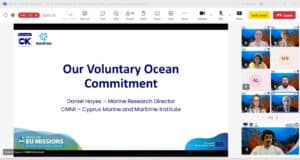 The event concluded with the announcement of a voluntary commitment to implement Sustainable Development Goal 14 (SDG 14) by Daniel Hayes, Director of Marine Research at the Cyprus Marine and Maritime Institute and coordinator of Mr.Goodfish3.0, on behalf of both projects.
His closing remarks focused on the joint efforts and momentum generated by the projects, highlighting how their collaboration contributes to more responsible seafood consumption and production in Europe:
- Improving transparency and traceability: Developing and harmonizing verifiable data systems throughout the seafood value chain, including post-harvest.
- Empowering consumers: Using digital tools and education to raise awareness of sustainable and lesser-known seafood species.
- Promoting co-creation: Engaging fishermen, aquaculturists, scientists, and consumers in the design of tools, policies, and campaigns.
- Support responsible aquaculture: Encourage innovations in animal welfare, feed alternatives, and circular systems to reduce environmental impacts.
- Encourage local and seasonal consumption: Provide scientific recommendations tailored to regional ecosystems and cultural habits.
- Improve ocean literacy and youth engagement: Use schools, social media, and public campaigns to cultivate a new generation of well-informed seafood consumers.
A Call for Collective Action
The event emphasized that protecting the oceans does not mean giving up seafood, but rather making better choices based on solid information, collaborative innovation, and shared responsibility. Through initiatives such as Mr.Goodfish 3.0 and VeriFish, new tools and knowledge are being developed to help consumers, producers, and policymakers act in the best interests of people and the planet.
To attempt to answer our initial question, “Can we still eat seafood?” But, as we deeply noted during our discussion, today’s informed choices shape the ocean of the future: Today’s informed choices shape the ocean of tomorrow.