What is an electric trawl?
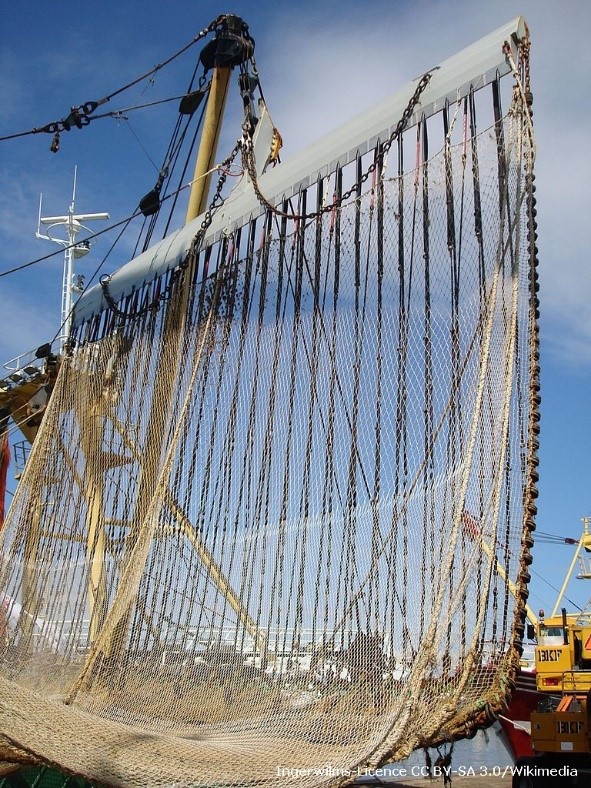
A trawl is essentially a large, funnel-shaped net towed behind a vessel. In this technique, it is specifically a beam trawl. It is characterized by a large rigid beam that helps open the net. Attached with chains, it scrapes the seabed to bring up demersal flatfish (sole, flounder, etc.) and shrimp, which are the targets of this technique.
The electric trawl was designed to reduce the ecological impact on the ecosystem and improve the vessel’s energy efficiency. The principle of this method involves placing electrodes along the net. The current then passes through the mesh and is diffused onto the seabed; the electrical impulse paralyzes the fish, propelling them out of the sandy substrate and into the trawl.
Who uses electric trawling?
Since 2006, the European Commission has granted experimental exemptions to each member state fishing in the southern North Sea. Officially, each European country concerned could equip 5% of its beam trawl fleet with electrodes. Since French and English fishermen rarely use this technique, these authorizations have mainly benefited the Dutch fleet, which is reported to have improperly equipped 30% of its vessels.
Since these exemptions were introduced, Dutch fishermen have sought to have this technique recognized as a conventional fishing method by the European Commission. This proposal would allow the entire Dutch fleet to legally use “pulse electric fishing.”
Why is there a debate surrounding this technique?
An increasing number of fishermen along the North Sea coast are mobilizing against the use of this fishing technique. Among their concerns, it appears that in areas where electric trawling coexists with other methods (nets, bottom trawling), the biomass of flatfish is in decline. When comparing the quantities caught by each method, it appears that electric fishing is highly effective and far surpasses conventional methods. Furthermore, fishermen highlight the physical impact of this technique on organisms (fractures, burns, etc.).
Conversely, the Dutch highlight the positive ecological and economic impact of this technique. By adjusting the voltage in the trawl, Dutch fishermen believe they can select larger individuals (based on size, fat content, etc.) and thus release fish that have not reached market size. Furthermore, since the electrical pulse is designed to “draw out” flatfish, contact between the trawl and the seabed is minimized. Ecologically, this technique thus reduces its impact on the seabed, and economically, it helps lower the vessel’s fuel consumption.
Today, two opposing views are at odds: one calling for a total ban on this technique and the other seeking its legalization and integration as a conventional fishing method.
The entire French fishing industry has campaigned against this technique among professional fishermen. After several years of advocacy, the three European institutions (the European Commission, Council, and Parliament) jointly decided on Wednesday, January 12, to impose a total ban on electric fishing by June 2021. During these two years of transition, the regulations will be strictly enforced in the Netherlands: only 5% of the fleet will receive an exemption to be authorized to use an electric trawl.
On April 16, 2019, the European Parliament approved the trilogue agreement reached on February 13, 2019, regarding the “Technical Measures” regulation. As of July 1, 2021, the use of electric trawls will be permanently banned in European waters.
On Thursday, May 9, 2019, members of the French National Assembly voted unanimously in favor of a bill to ban electric fishing in French territorial waters starting this year. The bill brings forward the ban date voted on April 16 at the European Union level, which will not take effect until July 1, 2021.
If definitively adopted by the Senate, this French law will ban this type of fishing in French territorial waters (12 nautical miles from the coastline) as of its publication. »
What is the Mr.Goodfish program’s position?
Following the latest reports from ICES (International Council for the Exploration of the Sea) and IFREMER (French Research Institute for Exploitation of the Sea) regarding the use of electric pulse fishing gear, Mr.Goodfish aligns with the opinions of scientific experts and recommends caution.
Indeed, previous studies are based on a limited number of observations or experiments. Certain effects remain to be studied, such as the medium- and long-term impact of using this gear, particularly on reproduction (sexual maturity, etc.) as well as on the development of eggs and larvae. Negative effects on these life cycle stages would be a cause for concern regarding population renewal.
Analyses regarding disruptions to the immune system must also be conducted. More generally, it is imperative to study the impact of this practice, which could have catastrophic effects on benthic fauna, meiofauna, the food web, and ecosystem functioning.
Access the Ifremer report: wwz.ifremer.fr_Electric fishing