Fish
Flathead grey mullet
Mugil cephalus
Out of season
—
Fishing zones
Wild
Origin
33 cm
Minimum size
Description
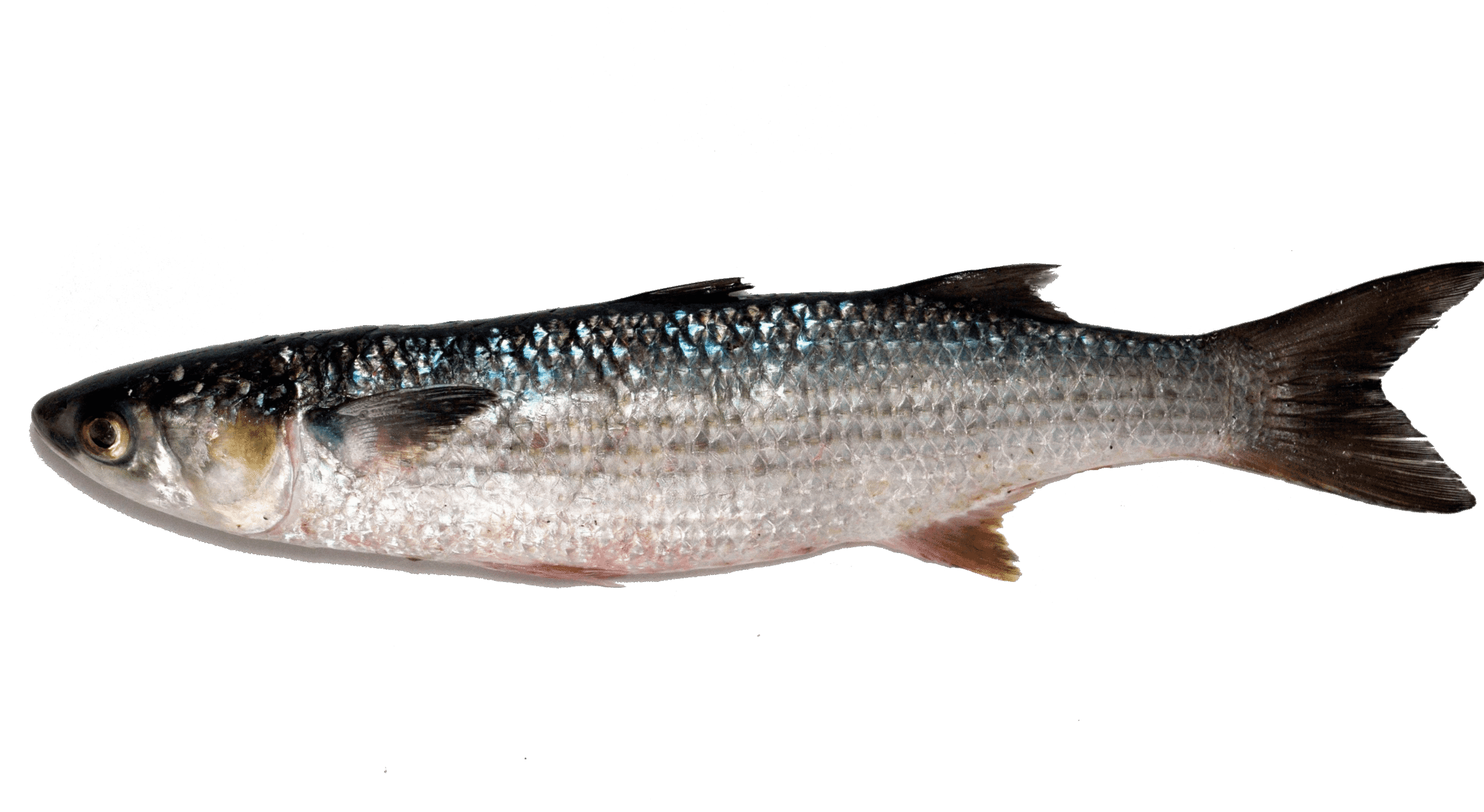
Its body is robust, cylindrical, and elongated. The head is broad and flattened on top, with a small, terminal mouth. It has a well-developed nictitating membrane (transparent tissue) covering most of the eye. The back is olive-gray or bluish, and the sides are silvery with dark longitudinal stripes (usually 6 to 7 stripes). The belly is silvery white, with two well-separated dorsal fins, the first with 4 hard spines. Its pectoral fins are short.
Habitat
This is a euryhaline species, meaning it can tolerate wide variations in salinity. It is found in marine environments, brackish waters (estuaries, lagoons), and frequently ventures into freshwater (rivers). It is generally found between 0 and 10 meters, but can descend to depths of up to 120 meters. It is a gregarious species that often forms large schools. The common mullet is famous for leaping out of the water. It feeds mainly on microscopic algae, organic detritus, and small benthic organisms that it filters from the sand or mud.
Distribution
The flathead grey mullet has a global distribution (found worldwide) in temperate, subtropical, and tropical waters. In the Atlantic: From the Bay of Biscay to South Africa, and from Nova Scotia (Canada) to Brazil. In the Mediterranean and Black Sea: Very common throughout the basin. In the Pacific: From the Sea of Okhotsk and Japan to Australia; from the United States to Chile. In the Indian Ocean: Found from the Red Sea to South Africa.