Fish
Poisson
Sardine
Sardina pilchardus
(GSA7) Gulf of Lion, (GSA9) Ligurian and Northern Tyrrhenian Sea, (GSA10) Central and Southern Tyrrhenian Sea, (GSA20) Eastern Ionian Sea
Fishing zones
Wild
Origin
15 cm
Minimum size
Description
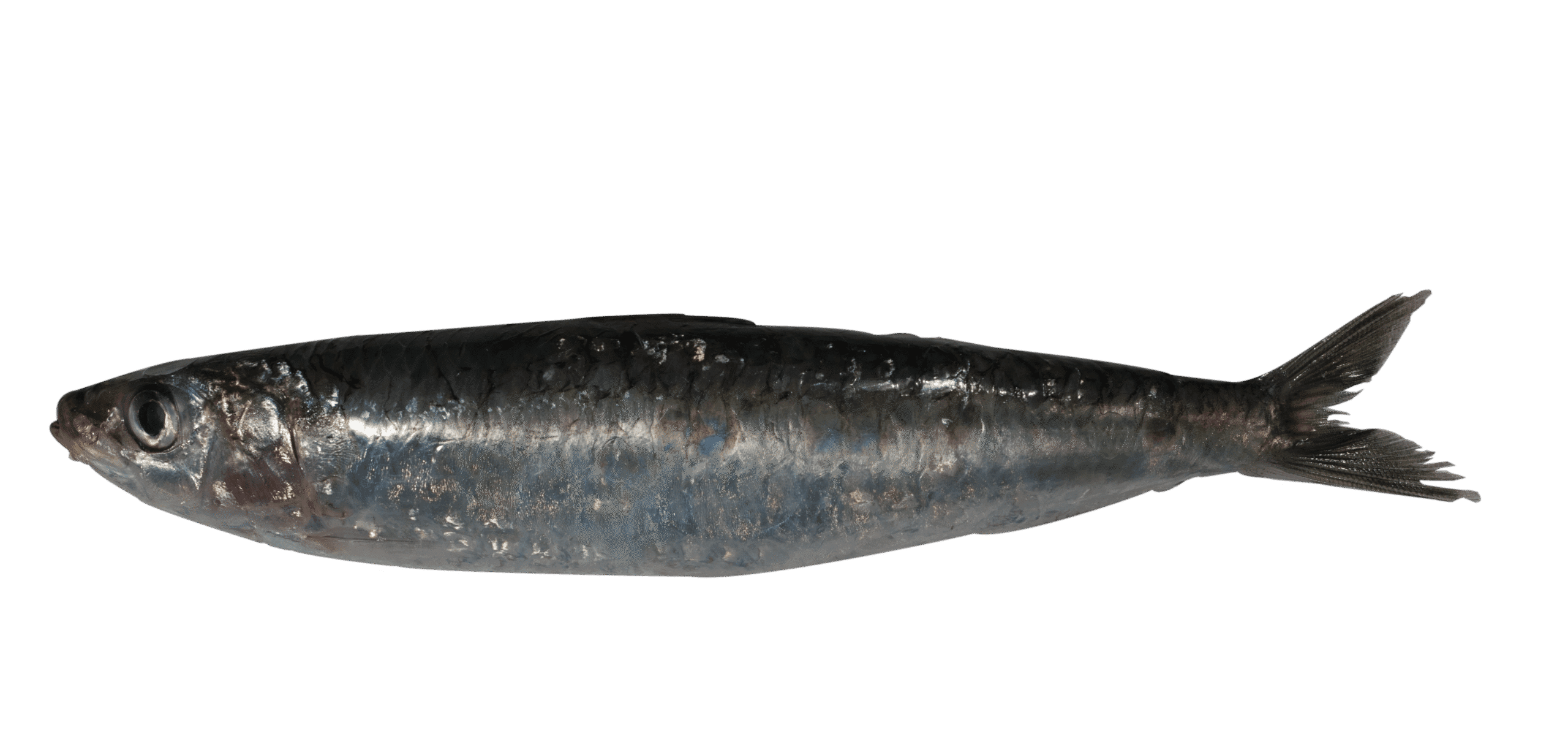
The body is elongated, sub-cylindrical, and relatively robust. The belly is rounded without a sharp keel. The back is blue-green to olive, with silvery flanks and belly. It features distinct radiating bony striae on the operculum (gill cover). A row of dark spots is often present along the upper flanks. The dorsal fin originates well ahead of the midpoint of the body.
Size: Commonly 15 to 20 cm, maximum length up to 27.5 cm.
The sardine is a planktivore (filter feeder). It feeds mainly on small planktonic crustaceans (such as copepods) as well as phytoplankton (diatoms), which it filters from the water using its specialized gill rakers.
Size: Commonly 15 to 20 cm, maximum length up to 27.5 cm.
The sardine is a planktivore (filter feeder). It feeds mainly on small planktonic crustaceans (such as copepods) as well as phytoplankton (diatoms), which it filters from the water using its specialized gill rakers.
Information
Habitat
It is a coastal, pelagic marine fish that forms dense schools. It is mainly found at depths between 10 and 100 meters (sometimes down to 150 meters at night). It exhibits daily vertical migrations, staying near the bottom during the day and rising to the surface at night.
Distribution
Northeast Atlantic: From southern Norway (rare) and the North Sea down to Senegal.
Inland Seas: Abundant throughout the entire Mediterranean Sea (very common in the Adriatic and Tyrrhenian seas), the Sea of Marmara, and the Black Sea.
Inland Seas: Abundant throughout the entire Mediterranean Sea (very common in the Adriatic and Tyrrhenian seas), the Sea of Marmara, and the Black Sea.