Fish
Poisson
Red gurnard
Aspitrigla cuculus
Out of season
—
Fishing zones
Wild
Origin
25 cm
Minimum size
Description
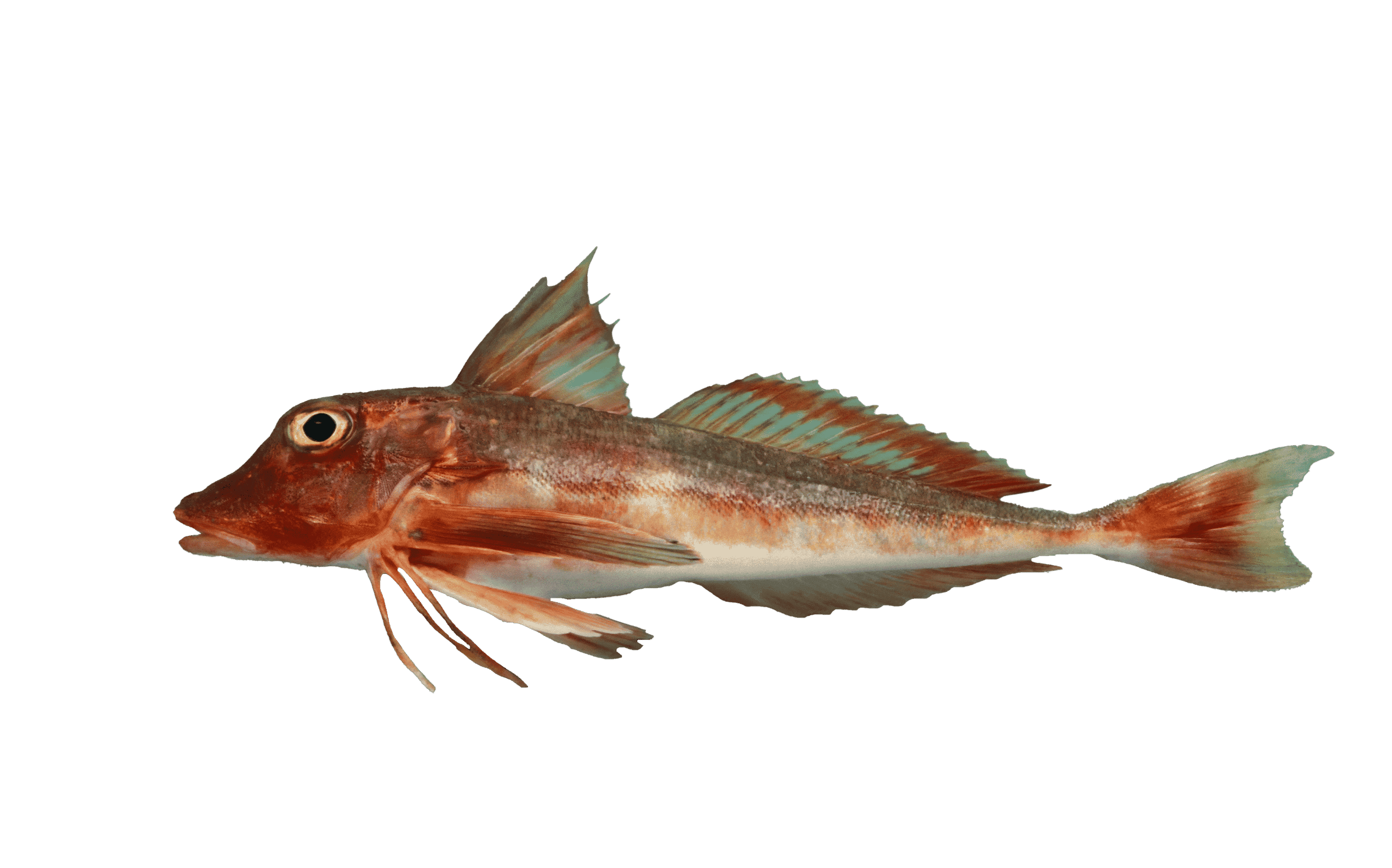
Its body is elongated and its head is massive, protected by bony plates. The snout is short and ends in two small points on each side. The first three rays of its pectoral fins are free, jointed, and movable. They serve as tactile organs for walking along the bottom and detecting buried prey. Its skin is heavily marked and consists of large transverse bony scales that resemble small plates. Its coloration is a bright, vivid red on the back and flanks, lightening to a pinkish-white on the belly. Its pectoral fins lack the iridescent blue spots found in other gurnard (such as the striped goby). Its average size is 20 to 30 cm, but it can reach a maximum of 50 cm.
Habitat
It is a benthic fish (lives on the seafloor). It prefers sandy, gravelly, or rocky bottoms in coastal areas and on the continental shelf. It is generally found at depths of 20 to 250 meters, although it can descend to depths of up to 400 meters in certain areas. It uses its free pectoral fins to sift through the sediment in search of small crustaceans, mollusks, and worms. Like other gurnards, it is capable of producing sounds (grunts) by vibrating its swim bladder, hence its name.
Distribution
It is common in the English Channel, the Bay of Biscay, and throughout the Mediterranean Sea. However, it is not found in the Black Sea. It is found from southern Norway and the British Isles to the coast of Mauritania, including the Azores, Madeira, and the Canary Islands.