Crustacean
European lobster
Homarus gammarus
(GSA7) Gulf of Lion, (GSA8) Corsica, (IV) North Sea, (VIIe) Western English Channel, (VIIIa) Bay of Biscay - North
Fishing zones
Wild
Origin
9,7 cm - 11 cm
Minimum size
Description
9.7 cm in the North-East Atlantic and 11 cm in the Mediterranean (carapace length).
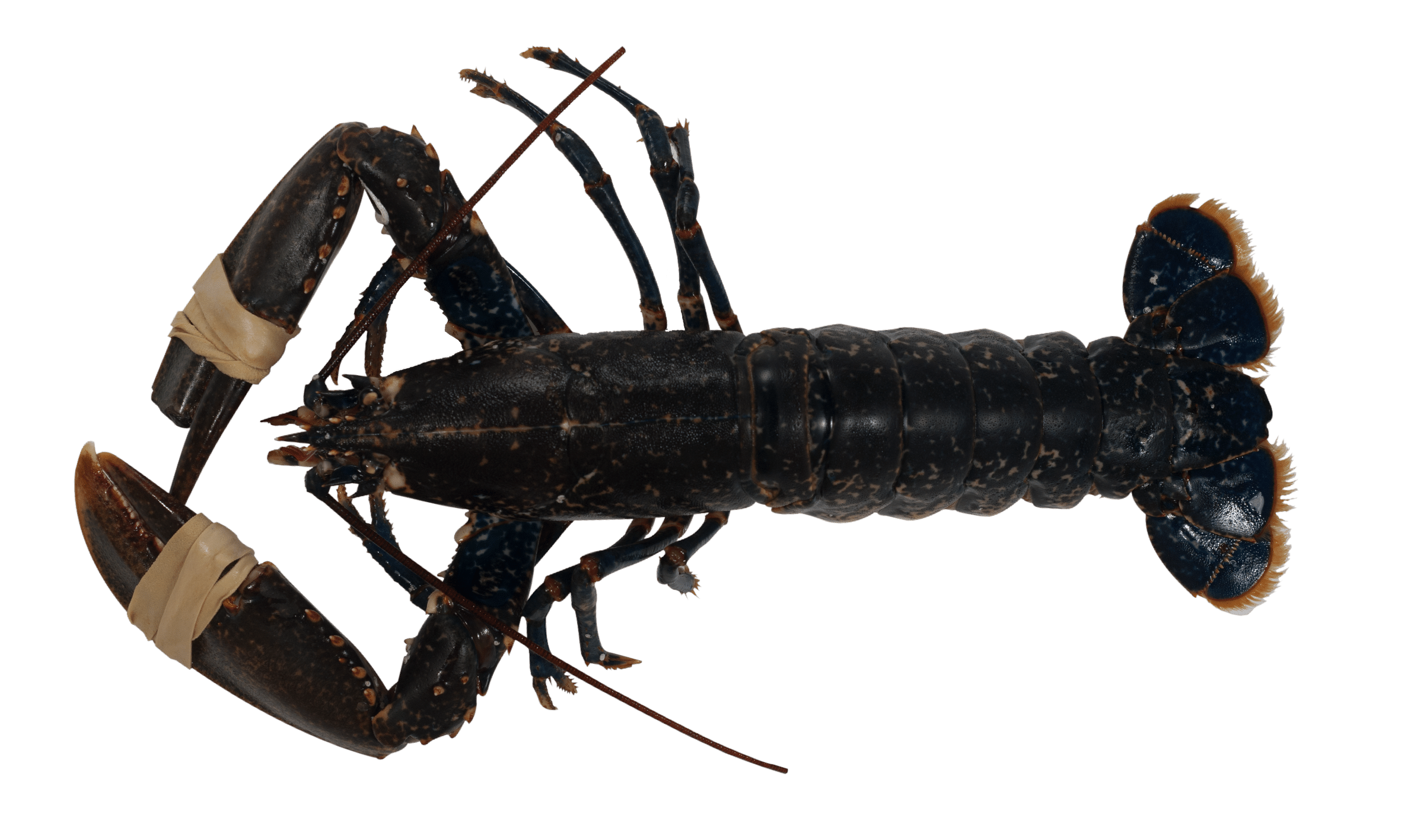
It is a large decapod crustacean with a thick, rigid shell. It has two pairs of antennae (one long and one short) and five pairs of legs. Its most striking feature is its pair of massive, asymmetrical claws: the crushing claw (wider and serrated) for breaking shells, and the cutting claw (thinner and sharper) for shredding the flesh. When alive, it displays a magnificent dark blue, midnight blue, or purplish color, with lighter (yellowish or white) spots on the belly and joints. It turns red only after cooking. Its average size is 25 to 50 cm, but it can reach a maximum length of 60 cm and weigh over 5–6 kg. Some very old specimens may be even larger.
It is a large decapod crustacean with a thick, rigid shell. It has two pairs of antennae (one long and one short) and five pairs of legs. Its most striking feature is its pair of massive, asymmetrical claws: the crushing claw (wider and serrated) for breaking shells, and the cutting claw (thinner and sharper) for shredding the flesh. When alive, it displays a magnificent dark blue, midnight blue, or purplish color, with lighter (yellowish or white) spots on the belly and joints. It turns red only after cooking. Its average size is 25 to 50 cm, but it can reach a maximum length of 60 cm and weigh over 5–6 kg. Some very old specimens may be even larger.
Habitat
It is a benthic, solitary animal that lives on the continental shelf. It prefers rocky bottoms, fissures, cavities, and scree where it can hide during the day. It is found less commonly on coarse sandy bottoms if it can dig a burrow there. It is found from the intertidal zone (lower foreshore) down to a depth of about 150 meters, although it is most common between 0 and 50 meters. The lobster is a nocturnal animal. It remains hidden in its shelter (its burrow) during the day and emerges at night to hunt mollusks, other crustaceans, worms, or fish.
Distribution
It is very common in the English Channel, the North Sea, the Irish Sea, and the Bay of Biscay. It is also found throughout most of the Mediterranean Sea (though less common in the eastern basin) and in the Black Sea. Its range extends from northern Norway (and, more rarely, Iceland) to Morocco and the Azores in the south.