Fish
Atlantic cod
Gadus morhua
Out of season
—
Fishing zones
Wild
Origin
64 cm
Minimum size
Description
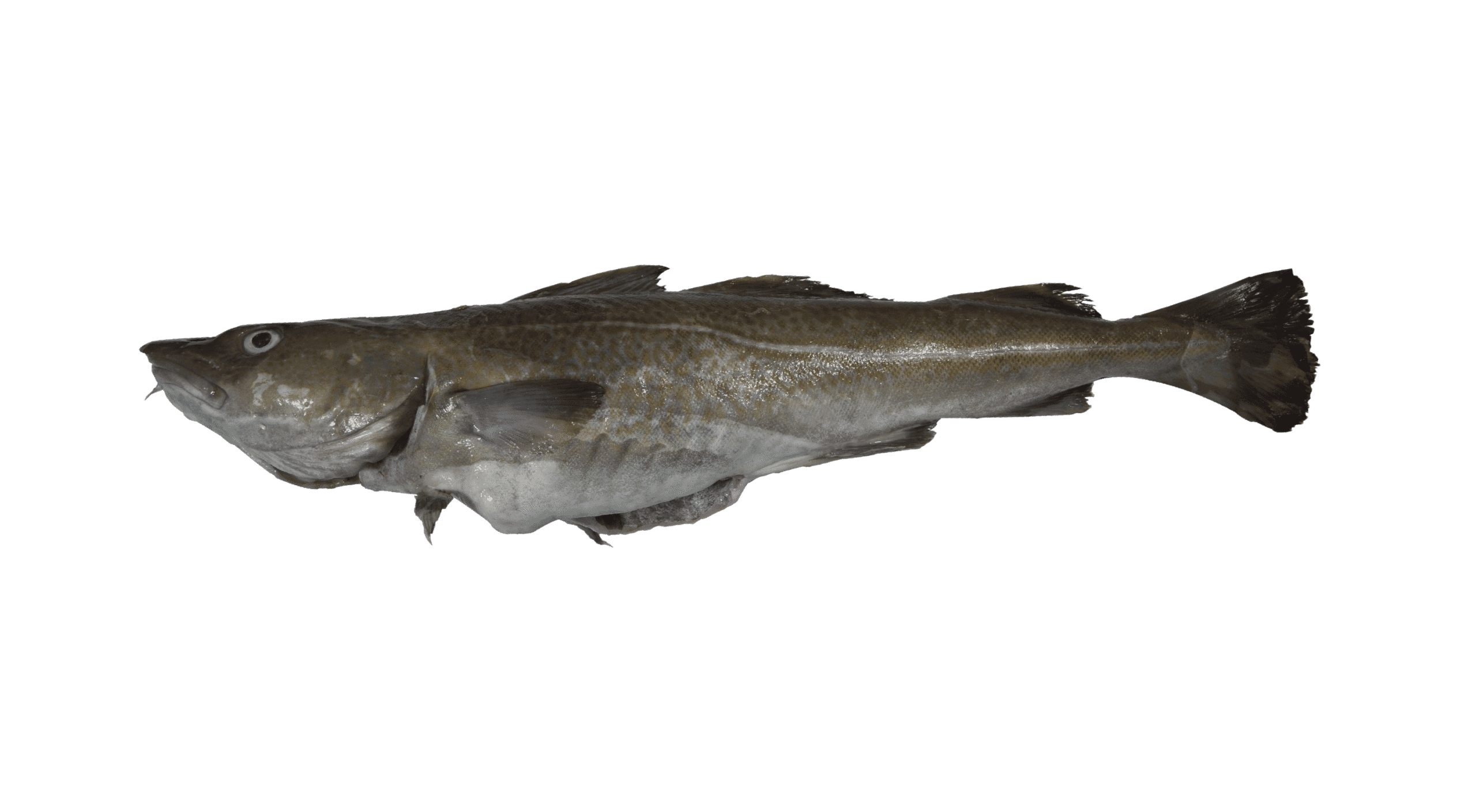
Well known to the public, cod—also called “morue” when dried and salted—is one of the most widely traded species. Its body is elongated and hydrodynamic. Its main characteristic is the presence of three dorsal fins and two anal fins, all clearly distinct and without spines. Its head features a prominent upper jaw and a very elongated and visible chin barbel (a sort of small mustache under the chin). It is an imposing fish. While the typical size ranges from 60 to 100 cm, it can exceptionally reach 2 meters in length and weigh up to 96 kg.
Information
Habitat
It is a benthopelagic fish (living near the bottom but capable of swimming in open water). It is found from the coast to the edge of the continental shelf, generally between 150 and 200 meters, although it can descend to depths of up to 600 meters. It prefers cold waters, ideally between 0°C and 12°C. Juveniles often stay closer to the coast in seagrass beds or rocky areas for protection.
Distribution
Cod is found exclusively in the North Atlantic: from the Bay of Biscay in the south, northward through the English Channel, the North Sea, and the Baltic Sea, to the Barents Sea and around Iceland and Greenland. It is also found from Cape Hatteras (North Carolina) in the United States to Greenland, along the coasts of Canada (famous for the Grand Banks of Newfoundland).