Fish
Poisson
Red mullet
Mullus surmuletus
(GSA22) Aegean Sea, (VIIe) Western English Channel, (VIIf) Bristol Channel, (VIIg) Northern Celtic Sea, (VIIh) Southern Celtic Sea, (VIII) Bay of Biscay
Fishing zones
Wild
Origin
18 cm
Minimum size
Description
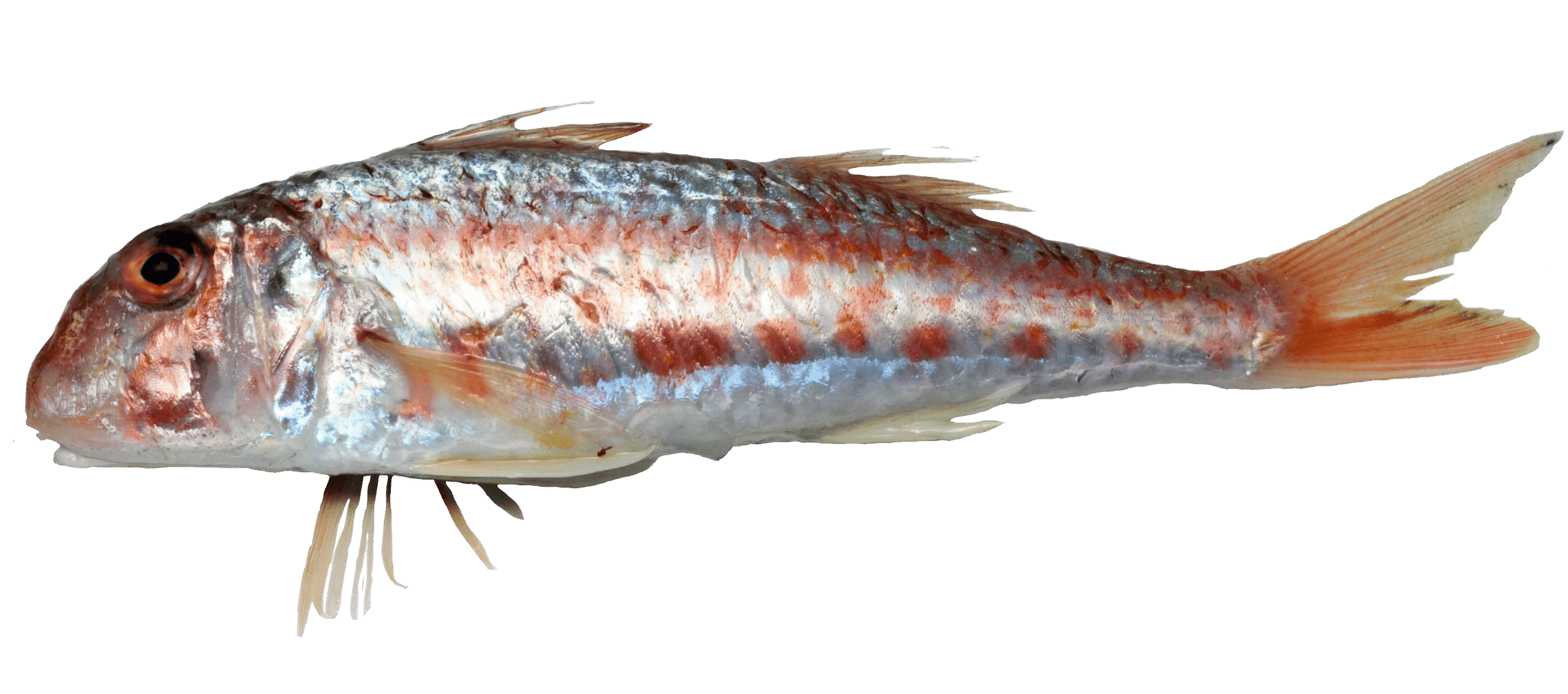
Unlike the red mullet (Mullus barbatus), which has a very vertical snout, the rock mullet has a more sloping snout (with a gentler angle). It has two chin barbels (under the jaw) that are longer than its pectoral fins. These barbels are sensory organs used to detect prey in the sand. The body is reddish to orange. It is distinguished by 3 to 5 yellow longitudinal stripes on the flanks and a characteristic black stripe on the first dorsal fin. It typically measures 20 to 25 cm, but can reach a maximum length of 40 cm. It feeds on benthic organisms such as small crustaceans (shrimp, amphipods), polychaete worms, and small mollusks.
Habitat
A marine, benthic, and sedentary species. It is found primarily on rocky bottoms, but also on sandy or gravelly bottoms (unlike the mud red mullet, which prefers soft, muddy bottoms). It generally lives at depths of 5 to 60 meters, although it can be found as deep as 400 meters. It is a gregarious species (lives in groups), often seen sifting through the substrate with its barbels to flush out its prey.
Distribution
It is found from southern Norway and Scotland to Senegal, including the Canary Islands and the Azores. It is very common in the English Channel and the North Sea. It is very common throughout the Mediterranean. It is also found in the Black Sea basin.