Shellfish
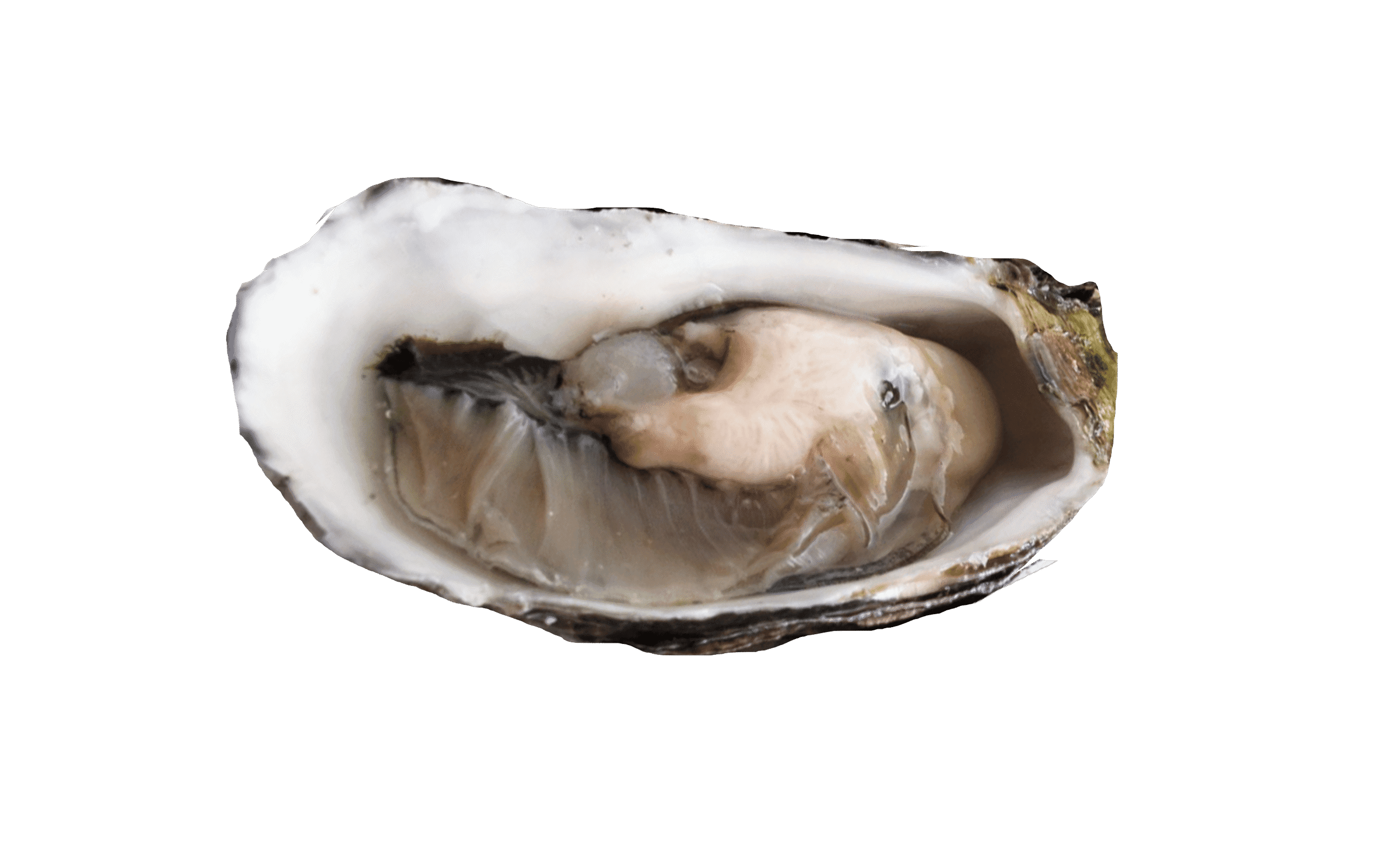
Farmed Pacific oyster
Crassostrea gigas
—
Fishing zones
Livestock farming
Origin
—
Minimum size
Description
Its shell is very irregular, elongated, and sturdy. It consists of two unequal valves: the left (lower) valve is concave and attached to the substrate, while the right (upper) valve is flatter and serves as a lid. The edges of the shell are typically wavy and sharp. The exterior is generally grayish, whitish, or yellowish, sometimes with purple or brown highlights. The interior is pearly white, often with a dark (purple or black) muscle spot. It is a very fast-growing species. Its market size is about 8 to 10 cm, but it can reach an exceptional size of 30 to 40 cm if left unharvested.
Habitat
It is a sessile bivalve mollusk that lives in the intertidal zone (foreshore) and the infralittoral zone. It is extremely hardy and tolerates wide variations in temperature and salinity (euryhaline). It particularly thrives in waters rich in phytoplankton. It attaches itself to any solid substrate: rocks, shell debris, or artificial structures (cultivation bags and tables). It is found primarily from the surface down to a depth of 5 meters, although it can go a little deeper.
Distribution
Because of its hardiness, it has been introduced by humans for aquaculture in nearly all of the world’s temperate seas: in Europe, where it was introduced on a massive scale in the 1970s, it has become the dominant species. In the Americas, it is found along the Pacific and Atlantic coasts (from Canada to Chile). In Oceania, it is found in Australia and New Zealand.