Have you noticed that, for several seasons now, new plant species have been added to the Mr.Goodfish list?
Following edible seaweed, we’ve included certain coastal plants found mainly in the eastern English Channel and in estuaries, such as sea aster, sea purslane, and glasswort.
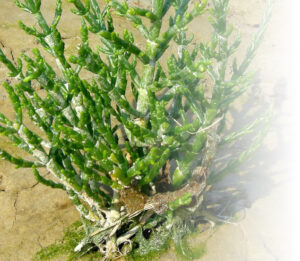
SALICORNIA
Scientific name: Salicornia procumbens
Common names: “Perce-pierre,” “Passe-pierre,” “Sea bean”
Harvest season: June to August (depending on prefectural regulations)
Did you know? Accounting for 80% of French production, the Baie de Somme is the most important region for harvesting these plants.
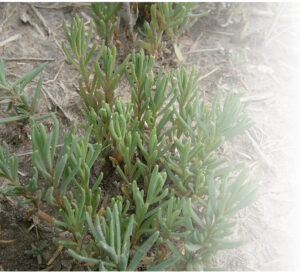 SALICORNIA
Scientific name : Salicornia procumbens
Nickname: “Pompon”
Harvest period: June to August (depending on prefectural regulations)
Did you know? For many years, it has been used in the production of artisanal soda. Once burned, its ashes are one of the ingredients in soap.
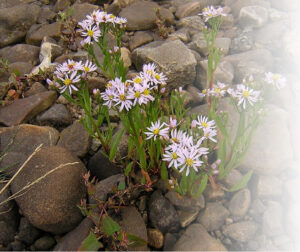 SEA ASTERS Scientific name : Aster tripolium
Common names: “pig’s ear,” “sea spinach”
Harvest period: March to October (depending on prefectural regulations)
Did you know? Only the leaves are eaten. When harvesting, it is necessary to leave a one-centimeter stem when cutting.
These plants grow on the foreshore between freshwater and seawater, at the mercy of the winds. They are halophytes (from the ancient Greek halo = salt, phile = to love), thriving in salt-rich soils known as “salt marshes.” Due to their location, they all have a more or less pronounced salty taste depending on the species.
Rich in vitamins, minerals, and trace elements (potassium, magnesium, etc.), they are perfect for promoting good health. They can be prepared in many ways to suit individual tastes: raw in a salad, pickled in vinegar, or simply sautéed with a suitable accompaniment (garlic, onion, cream, etc.).
The technique for gathering them is simple: a knife, a basket, and two hands—the best method for longer shelf life. Note, however, that it’s best to go foraging for these coastal plants early in the morning. They’re still full of water, giving them a fresh, crisp texture—ideal for eating! Note: these plants are subject to regulations; check the prefectural decrees in effect for the department where you’re harvesting.
If you’d like to learn more, feel free to contact the Association of Salicornia Gatherers of the Baie de Somme
. It brings together all the beachcombers who gather marine plants, and they’ll be happy to guide you toward many recipes.
Did you know?
In the eastern Channel region, primarily in the Baie de Somme, the harvesting of marine plants is a traditional activity that has existed for generations. A few years ago, the creation of the “professional shore fisherman” status led to the recognition of this activity and the establishment of a regulatory framework. Today, to harvest marine plants professionally in Pas-de-Calais and the Somme, fishermen must hold a national permit issued by the government and a fishing license specific to these species.
For recreational fishermen, it is permitted to bring back 500 grams of each species per person per day.
A little tip
: The harvest season for marine plants ends in late August—early fall, yet you can find and enjoy them year-round in jars! A real treat!