Crustacean
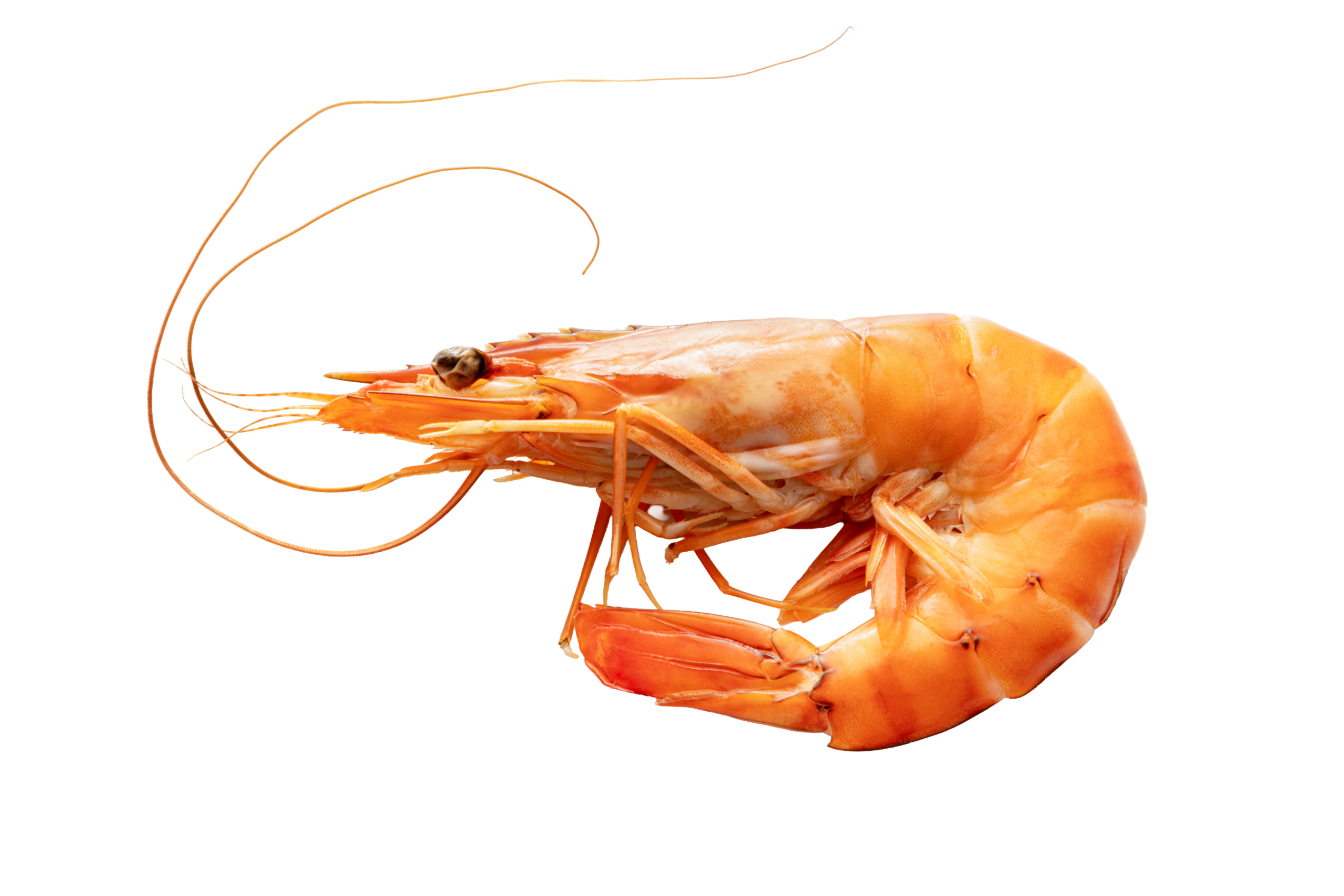
Northern shrimp
Pandalus borealis
(I) Barents Sea
Fishing zone
Wild
Origin
2,8 cm (Lc)
Minimum size
Description
The northern shrimp is a decapod crustacean with an elongated, relatively slender body, characterized by a smooth carapace and a long, toothed rostrum. It typically grows to 12 cm (up to 16.5 cm in females). It is dark red when alive and turns pink after cooking, hence its common name, “pink shrimp.” A free-swimming species that lives on the seafloor, it has an opportunistic feeding strategy and plays an important ecological role in northern ecosystems.
Habitat
It is a benthopelagic species that lives near the seafloor.
It inhabits mainly soft seabeds rich in organic matter (mud, sand, silt), but also rocky seabeds. It is generally found at depths ranging from 9 to 1,450 m, most often between 50 and 500 m.
It is found in cold waters ranging from -2 °C to 12 °C, with an optimum temperature of around 4 °C.
It inhabits mainly soft seabeds rich in organic matter (mud, sand, silt), but also rocky seabeds. It is generally found at depths ranging from 9 to 1,450 m, most often between 50 and 500 m.
It is found in cold waters ranging from -2 °C to 12 °C, with an optimum temperature of around 4 °C.
Distribution
The northern shrimp is widely distributed in the cold waters of the Northern Hemisphere.
It is found near the poles in the North Atlantic and North Pacific Oceans.
It inhabits cold-temperate to polar biogeographic zones. Globally, it is found between approximately 35°N and 82°N.
It is found near the poles in the North Atlantic and North Pacific Oceans.
It inhabits cold-temperate to polar biogeographic zones. Globally, it is found between approximately 35°N and 82°N.