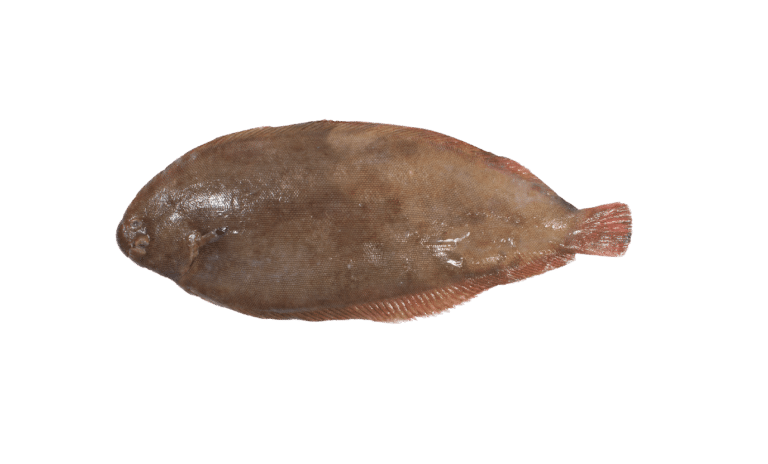
Today we’re giving you a glimpse into a day aboard a net fishing boat in Boulogne-sur-Mer!
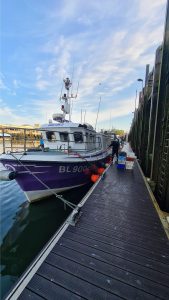 The sun hasn’t even risen yet, but the port is already starting to come alive. It’s usually around 2 or 3 in the morning when the gillnetter crews arrive at the docks. On average, there are 3 to 4 sailors on vessels ranging from 12 to 16 meters in length. First step: getting the boat underway. One by one, the lights come on, the engines purr, and the mooring lines are cast off. The crew sets a course for the fishing grounds. The sailors use this time—which can vary in length—to rest. Meanwhile, on the bridge, the VHF radio is on, and conversations between the captain and other boats flow freely, covering topics such as different fishing zones, market prices, or simply yesterday’s soccer game. The duration of the trip varies depending on the technique used, the season, the weather, and/or the target species.
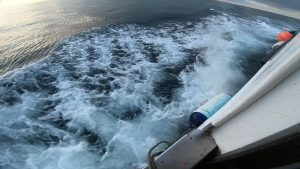 Once the area is reached, the nets set the previous day must be retrieved. The duration of immersion and the type of nets used depend on the target species and their fragility. Here, the catch consists mainly of flatfish (sole, flounder, etc.). There are several types of nets: gillnets, drift nets, or trammel nets. In Boulogne-sur-Mer, the gillnet is the most commonly used, hence the name “gillnetter” for these boats. The gillnet consists of three layers of netting with different mesh sizes: the two outer layers have large mesh, and the inner layer has small mesh. The fish become entangled in these different layers.
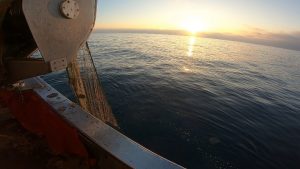 Each sailor has a specific role on the boat: one handles hauling in the net using the “net winch,” another untangles the trapped fish, and another operates the “net winder,” the machine used to roll up the net for storage. Depending on the quantity of fish caught, the hauling operation can be quite long, lasting up to several hours. Generally, the crew starts at night and finishes when the sun is already high in the sky. Since the nets are usually in the water for only a short time, the fish are of very high quality. Once the fish are in the crates, the crew must choose a new fishing area and set the trammel net back in the water. This is a quick operation that requires concentration from both the crew and the captain.
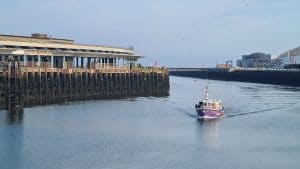 Once the nets are in the water, the boat heads “toward port” to unload the catch. Depending on how long it takes to haul in the nets and the fishing location, they return to port between 11 a.m. and 5 p.m. The day’s catch is unloaded onto the docks. In Boulogne-sur-Mer, some net fishermen own an “aubette,” a fish shop in the harbor where they sell part of their catch directly. The rest is transferred to the auction house’s refrigerators to be sold the following night.
Once ashore, the net fisherman’s captain has finished his day as a fisherman but begins his second life: administrative work, accounting, sales, etc. Today, being a sailor means being a multitasker.
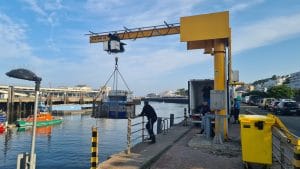 This type of boat goes out every day from Monday to Friday, but due to their size, they are highly dependent on the coastal zone (12 miles) and the weather. Today, more and more of these vessels are seeking to diversify their operations. They want to be less dependent on flatfish, for which stock levels in the English Channel and the North Sea are not always good. Some of them have adapted by adopting a new technique: the trap net—a story to watch…