Fish
Poisson
Tub gurnard
Chelidonichthys lucerna
(IV) North Sea, (VIId) Eastern English Channel, (VIIe) Western English Channel, (VIIf) Bristol Channel, (VIIg) Northern Celtic Sea, (VIIh) Southern Celtic Sea, (VIII) Bay of Biscay
Fishing zones
Wild
Origin
20 cm
Minimum size
Description
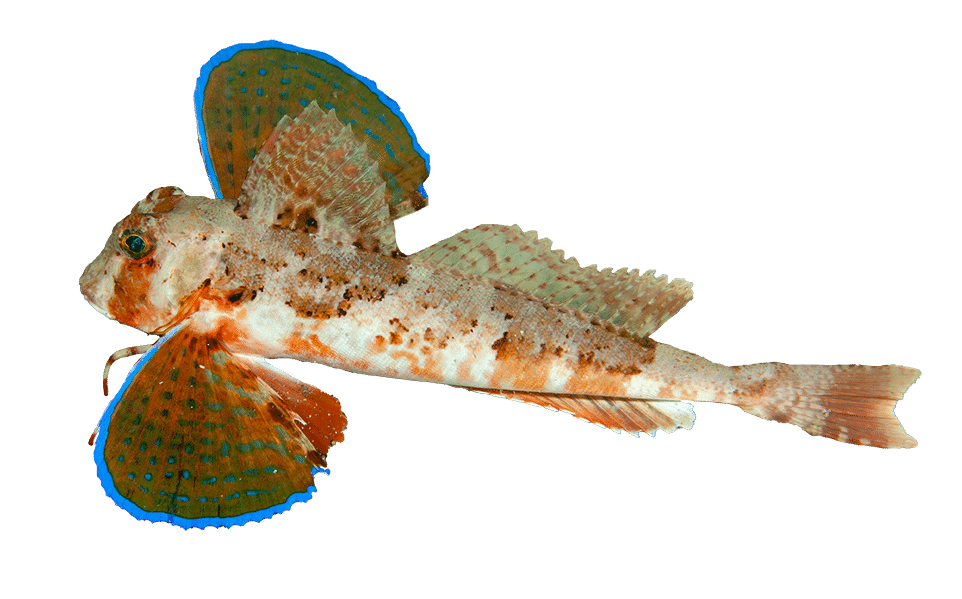
Its body is elongated, tapering toward the tail, with a massive head protected by bony plates. Its mouth is wide and positioned low on the head. Its pectoral fins are very large, resembling wings. Their inner surface is a brilliant blue with a red or pink border and often features iridescent green or blue spots. The first three rays of its pectoral fins are free, jointed, and finger-like. They allow it to walk along the bottom and possess sensory receptors for detecting prey (crustaceans, mollusks). The back is generally brick red, pink, or brownish, while the belly is silvery white. It is the largest of the gurnards. Its typical size is 30 to 40 cm, but it can reach a maximum of 75 cm and weigh up to 6 kg.
Habitat
It is a demersal fish that lives on the continental shelf. It prefers sandy, muddy, or gravelly bottoms, where it can use its free rays to sift through the sediment. It is capable of producing sounds (grunts or clicks) by vibrating its swim bladder using special muscles, hence its name "gurnard." It is found from the coastal zone (approximately 10–20 meters) down to depths of 300 meters. Juveniles are often found in the very shallow waters of estuaries.
Distribution
Very common in the English Channel, the North Sea, the Bay of Biscay, and throughout the Mediterranean Sea. It is also found in the Black Sea. Its range extends from Norway and the North Sea in the north to Mauritania and Senegal in the south.