Shellfish
Common cockle
Cerastoderma edule
Out of season
—
Fishing zones
Wild
Origin
2,7 cm
Minimum size
Description
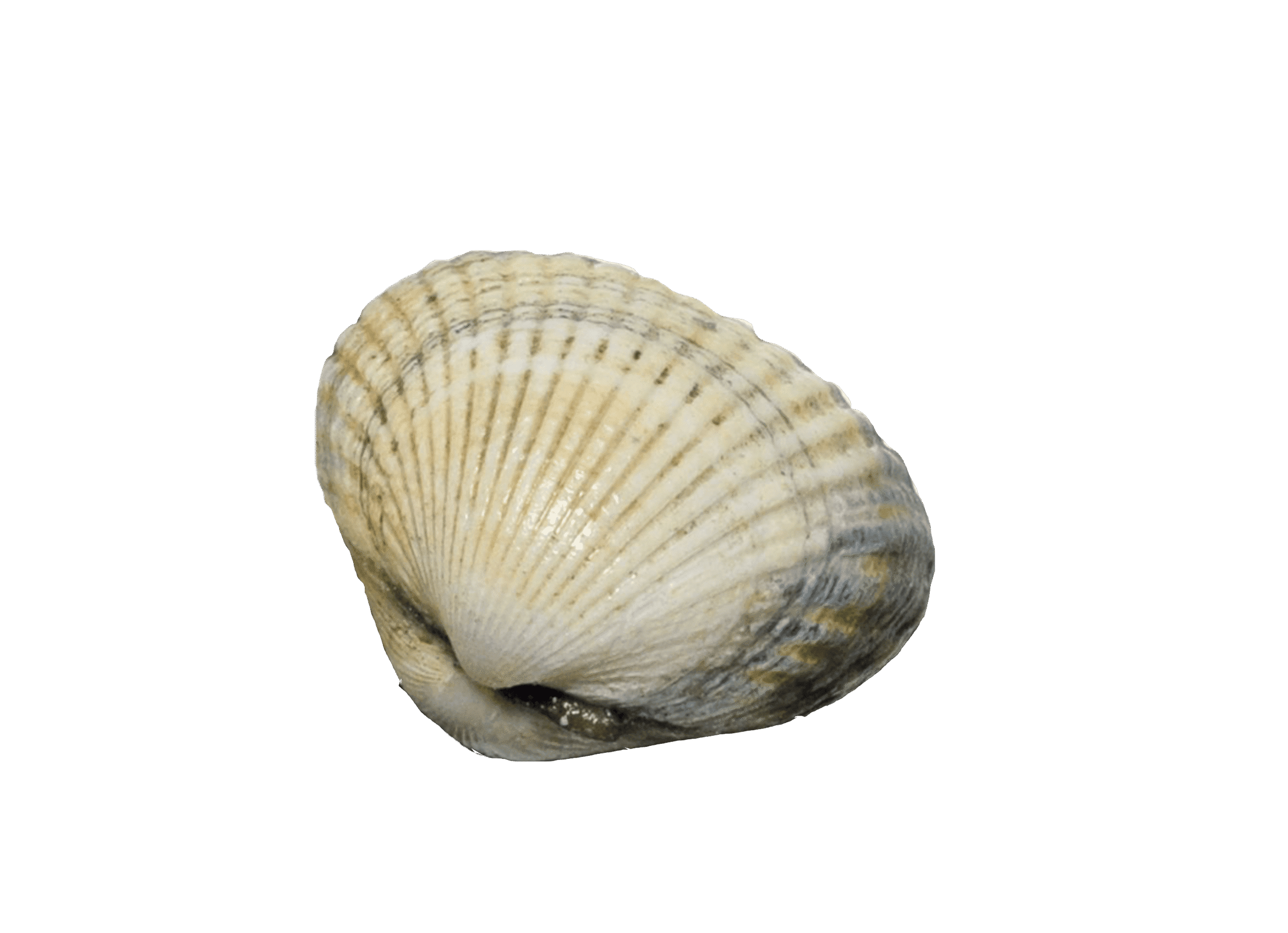
The common cockle is a species of bivalve mollusk in the family Cardiidae. It has a sturdy, equivalve (both halves are identical) and domed shell, roughly oval or heart-shaped when viewed in profile. The outer color ranges from off-white to beige or hazelnut brown, sometimes with brown spots. The interior is glossy white, often with a purplish spot near the impression of the posterior muscle. Its average size is 3 to 4 cm, but it can reach a maximum of 5 to 6 cm. It has a very powerful, elbow-shaped muscular foot that allows it to burrow quickly or even make small jumps to escape a predator (such as a starfish).
Habitat
This is a benthic species that lives buried just below the surface of the sediment (about 1 to 3 cm deep). It prefers clean sandy bottoms, silty sand, or fine gravel. It is found mainly in the intertidal zone (the area affected by the tides), particularly in sheltered bays and estuaries where salinity may be slightly lower. It is a filter-feeder that uses its two short siphons to suck in seawater and extract phytoplankton from it.
Distribution
It is found from the Barents Sea and Iceland in the north to the coast of Mauritania in the south. It is extremely abundant in the North Sea, the English Channel (particularly in the Baie de Somme and the Baie des Veys), and the Bay of Biscay. It is also present, though less common, in the western Mediterranean Sea.