Fish
Sea bass
Dicentrarchus labrax
(IVb) Central North Sea, (IVc) Southern North Sea, (V) Icelandic and Faroese Waters, (VIIa) Irish Sea, (VIId) Eastern English Channel, (VIIe) Western English Channel, (VIIf) Bristol Channel, (VIIg) Northern Celtic Sea, (VIIh) Southern Celtic Sea, (VIIIa) Bay of Biscay - North, (VIIIb) Bay of Biscay - Central
Fishing zones
Wild
Origin
42 cm
Minimum size
Description
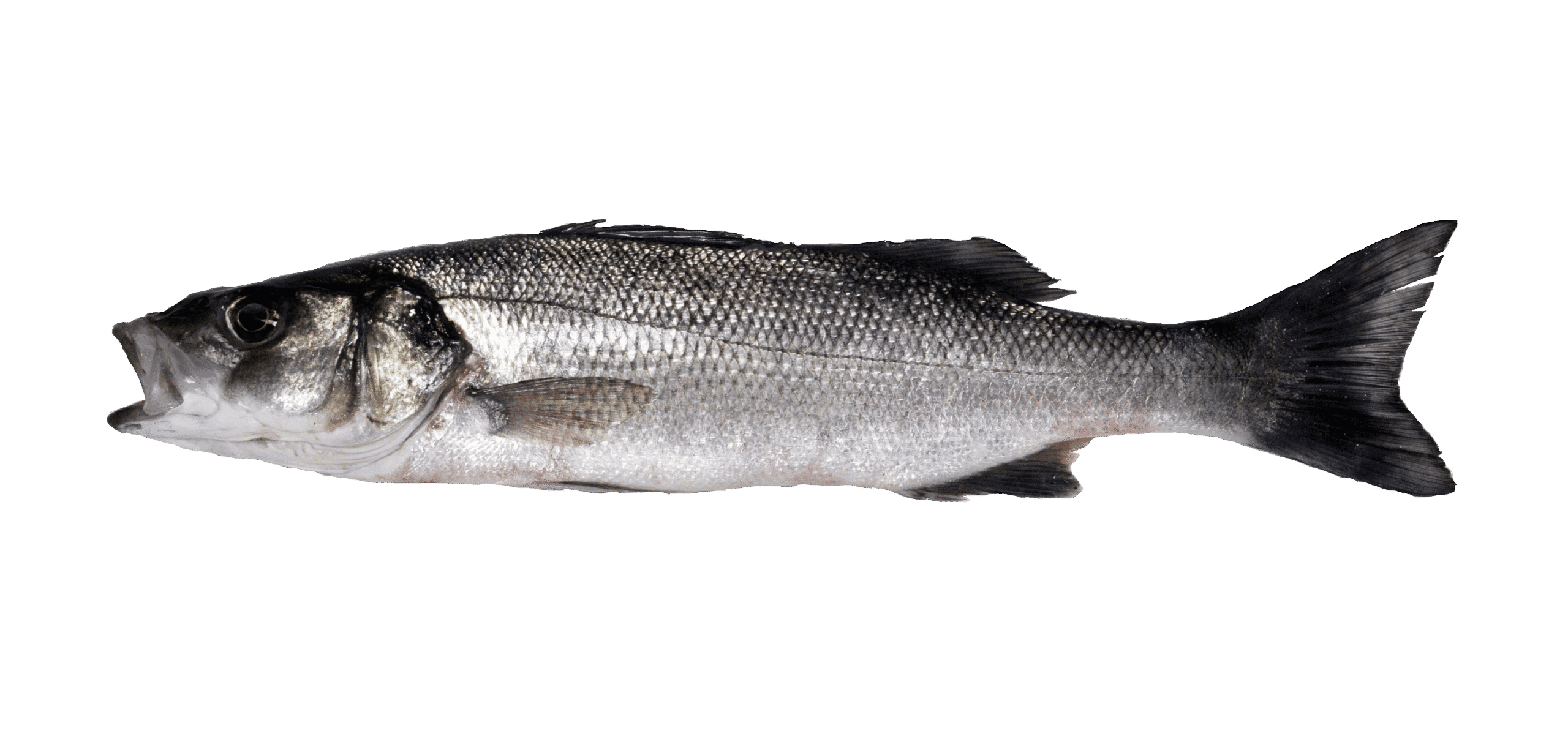
The European sea bass is a robust, elongated fish with two distinct, separate dorsal fins. The first is spiny (8 to 9 spines), while the second has only a single spine followed by soft rays. Its caudal fin is slightly forked. Its back is silvery-gray to bluish, its sides are silvery, and its belly is white or yellowish. It can reach a maximum length of about 100 cm, although the typical size is around 50 cm.
Habitat
It is found primarily in coastal waters (the littoral zone), estuaries, brackish lagoons, and sometimes even in freshwater (it occasionally swims upriver). It generally inhabits depths of 10 to 100 meters, although it is more common in shallow waters, near the surf and in rocky or sandy areas.
Distribution
Its geographic range is centered on the northeastern Atlantic and the Mediterranean.
From southern Norway and the British Isles to Morocco and the Canary Islands. Stray individuals are sometimes reported as far south as Senegal.
Found throughout the Mediterranean Sea and in the southern Black Sea.
From southern Norway and the British Isles to Morocco and the Canary Islands. Stray individuals are sometimes reported as far south as Senegal.
Found throughout the Mediterranean Sea and in the southern Black Sea.