Fish
Poisson
Pouting
Tripsoterus luscus
(IV) North Sea, (VIId) Eastern English Channel, (VIIe) Western English Channel, (VIIf) Bristol Channel, (VIIg) Northern Celtic Sea, (VIIh) Southern Celtic Sea, (VIII) Bay of Biscay
Fishing zones
Wild
Origin
25 cm
Minimum size
Description
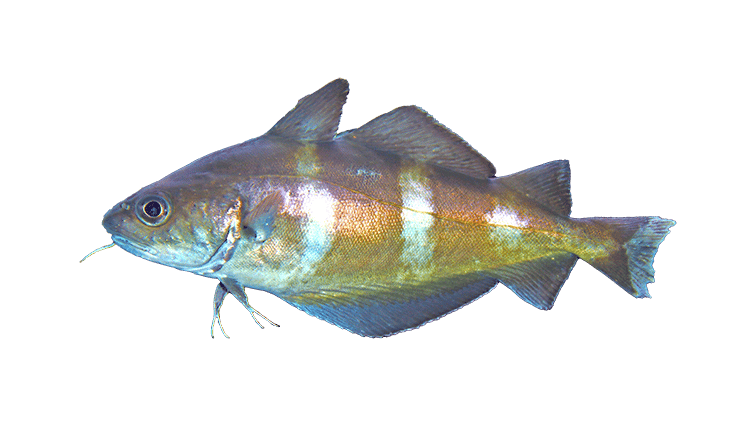
The body is fairly stocky, tall, and laterally compressed. It has a long, very distinctive chin barb below the lower jaw. It has three dorsal fins and two anal fins, all of which lack spines. The anal fins are fused at the base. The back is beige or coppery brown; the sides are lighter (silvery), often with 4 to 5 dark vertical bands that fade after death. A distinct black spot marks the base of the pectoral fins. Its typical size is 20 to 30 cm, but it can reach a maximum of 45 to 46 cm. It feeds mainly on small crustaceans (shrimp, crabs), mollusks, polychaete worms, and small benthic fish.
Habitat
A demersal (bottom-dwelling) and gregarious (schooling) marine species. It is found primarily at depths between 30 and 100 meters, although it can descend to depths of up to 300 meters. It particularly favors rocky bottoms, shipwrecks, and artificial reefs, where it shelters in dense schools during the day. Juveniles are found closer to the coast, sometimes in estuaries and sandy areas. It prefers temperate waters (between 7°C and 13°C).
Distribution
It is found from southern Norway and the British Isles to the coast of Morocco. It is extremely common in the English Channel, the North Sea, and the Bay of Biscay. It is found only in the western part (Alboran Sea, Gulf of Lion).