Fish
Poisson
Pollock
Pollachius pollachius
Out of season
—
Fishing zones
Wild
Origin
41 cm
Minimum size
Description
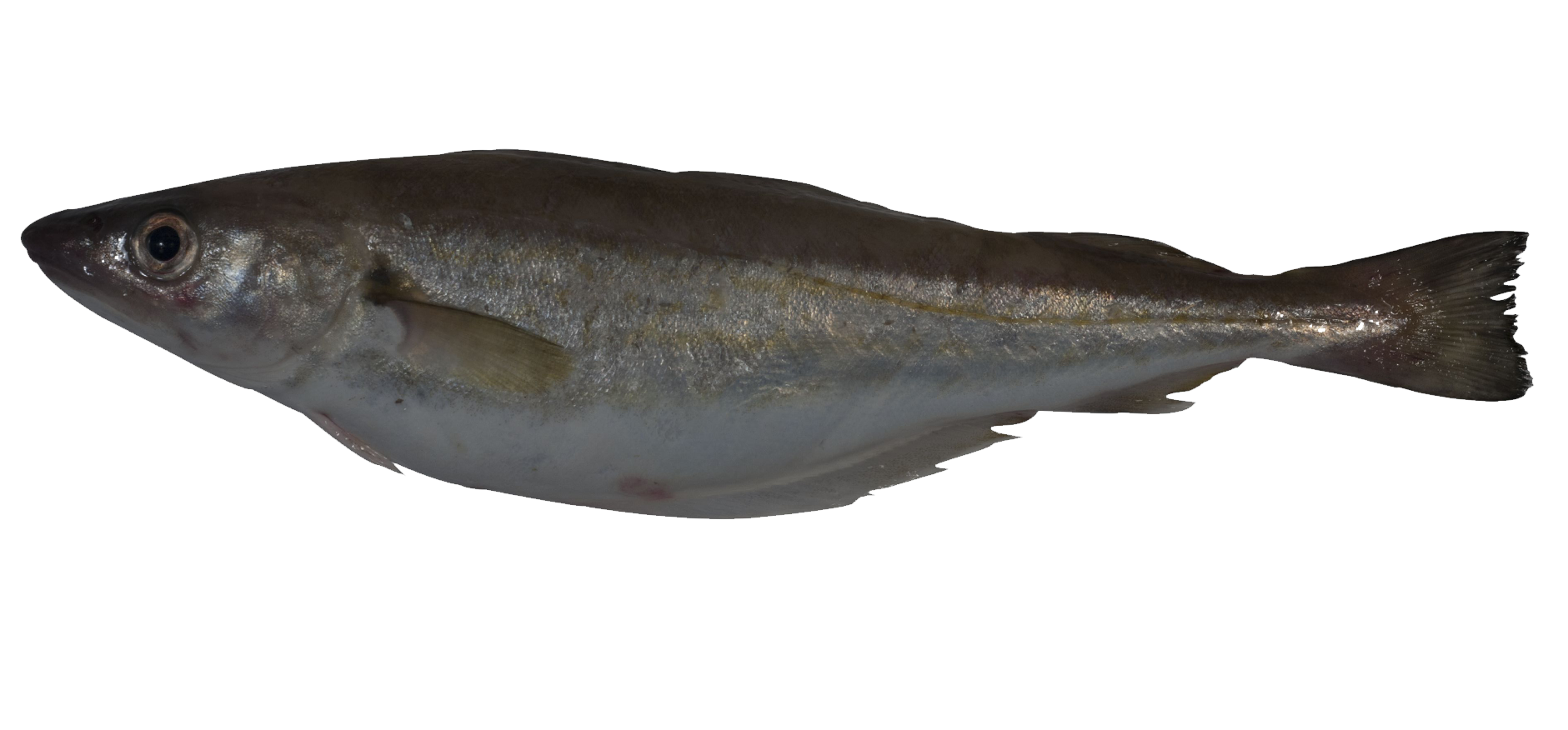
Its body is elongated and spindle-shaped. Its head is pointed and has one major distinguishing feature: its lower jaw is significantly longer than its upper jaw (prognathism). Like most Gadidae, it has three distinct dorsal fins and two anal fins. Its caudal fin (tail) is straight or slightly concave. It is highly visible and has a pronounced curve above the pectoral fin, which makes it easy to distinguish from the pollock (Pollachius virens), whose lateral line is straight. The back is generally brownish-green or olive, the sides are golden or yellowish with silvery sheen, and the belly is white. It has no barbels under the chin (or only a tiny remnant). Its typical size is 30 to 60 cm, but it can reach a maximum of 130 cm and weigh up to 18 kg.
Habitat
It is a benthopelagic fish that often lives alone or in small groups, unlike the saithe, which is more gregarious. It is closely associated with rocky bottoms, shipwrecks, and areas with strong currents. Juveniles spend their first two years near the coast, in kelp beds or shallow rocky areas. It is a voracious predator that feeds mainly on other fish (sand eels, herring, sprats) and cephalopods. It is generally found between the surface (for juveniles) and a depth of 200 meters.
Distribution
It is very abundant in the English Channel, the North Sea, the Irish Sea, and the Bay of Biscay. It is also found from northern Norway and Iceland to the coast of Morocco.