Fish
Poisson
Patagonian toothfish
Dissostichus eleginoides
58.5.1 ZEE Kerguelen, 58.6 Zee Crozet
Fishing zones
Wild
Origin
60 cm
Minimum size
Description
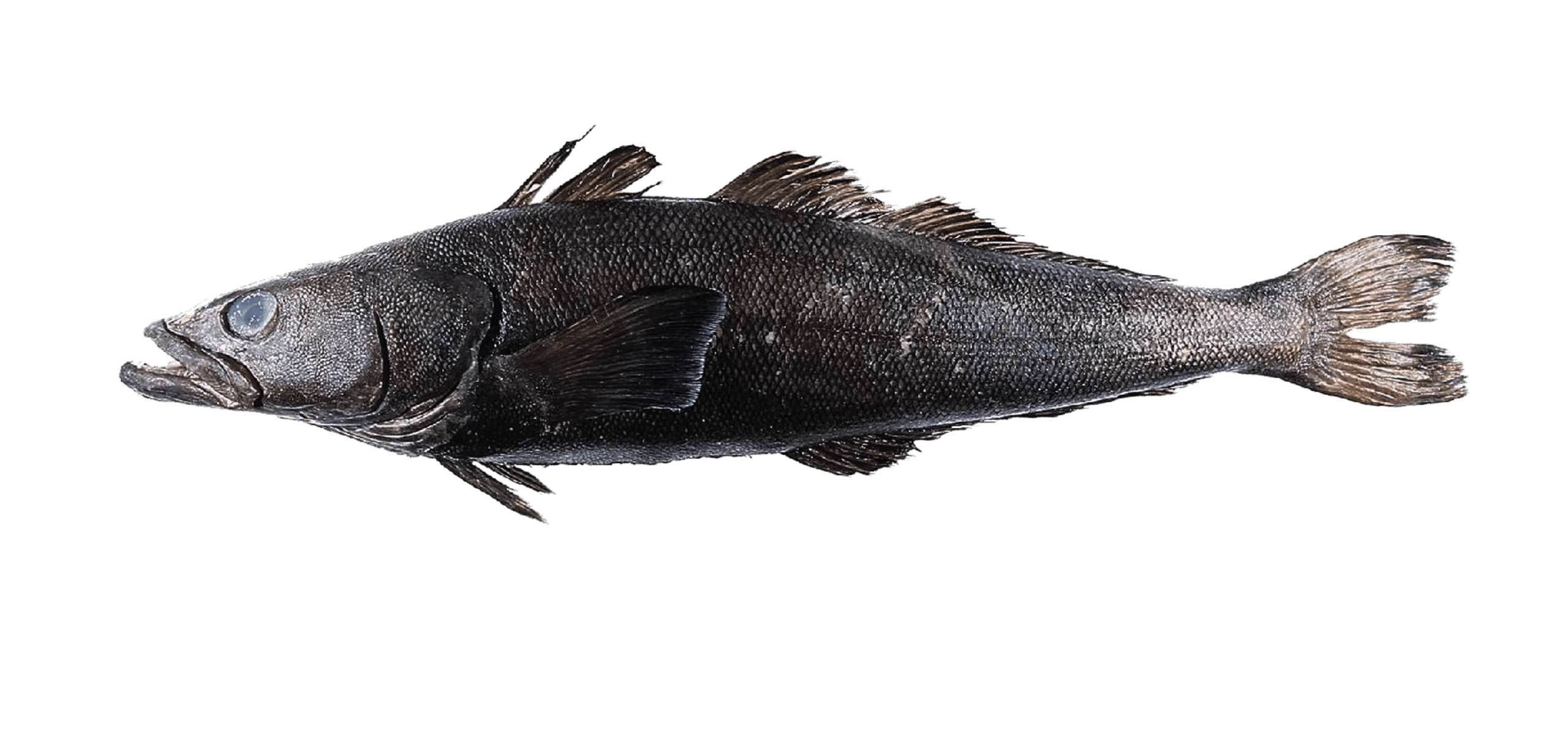
It is an imposing fish with an elongated, spindle-shaped body. Its head is broad, with a pointed snout and a mouth equipped with strong, sharp teeth (hence its English name, toothfish). It has two dorsal fins, the first of which is spiny. Its pectoral fins are broad and fan-shaped. Its coloration is generally dark gray to grayish-brown on the back, lightening toward the belly. The lateral line is clearly marked. It is a giant of the cold seas. It can reach a maximum length of 2.15 meters and weigh over 100 kg. It is a slow-growing species that can live for more than 50 years.
Habitat
It is a deep-sea benthopelagic fish. Juveniles live in the shallower waters of the continental shelf, while adults migrate to the abyss. It is an opportunistic predator that feeds on fish, cephalopods, and crustaceans. It is generally found between 300 and 2,500 meters, but has been observed at depths of up to 3,800 meters. It is perfectly adapted to extremely cold waters (close to 0°C) thanks to antifreeze proteins in its blood.
Distribution
It is confined to the cold waters of the Southern Hemisphere (circumpolar region). It is found around the southern tip of South America (Chile and Argentina), south of New Zealand and Australia. It is abundant around the Kerguelen, Crozet, Heard, and McDonald Islands, as well as the Falkland Islands. France manages one of the world’s largest toothfish fisheries in its French Southern and Antarctic Lands (TAAF), primarily around the Kerguelen and Crozet Islands.