Shellfish
Manila clam
Ruditapes philippinarum
(VIIe) Western English Channel, (VIIf) Bristol Channel, (VIIg) Northern Celtic Sea, (VIIh) Southern Celtic Sea, (VIII) Bay of Biscay
Fishing zones
Wild
Origin
4 cm
Minimum size
Description
In accordance with current regulations.
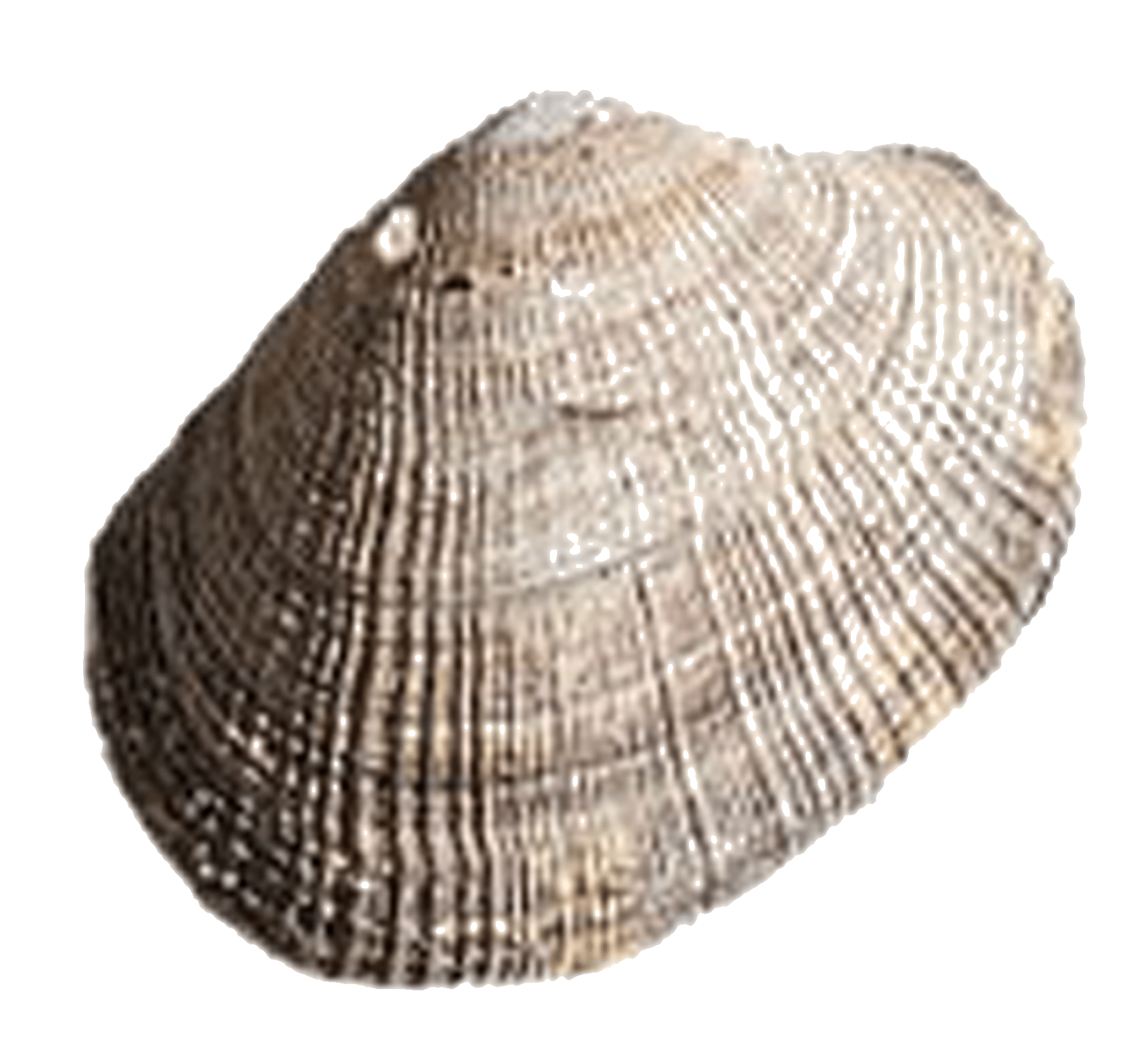
Its shell is oval and elongated, with radial ribs and very distinct concentric striations, giving it a "lattice" or "grid" appearance. Its color varies greatly. The outer surface may be gray, beige, yellowish, or brown, often adorned with geometric patterns, spots, or darker broken lines. The inner surface is generally white with a purple tint along the posterior edge. Its siphons (used to filter water) are fused along most of their length, which distinguishes it from the European clam (Ruditapes decussatus), whose siphons are separate. It typically measures between 4 and 5 cm, but can reach 8 cm. It is a filter-feeder that feeds on phytoplankton and suspended organic matter.
Its shell is oval and elongated, with radial ribs and very distinct concentric striations, giving it a "lattice" or "grid" appearance. Its color varies greatly. The outer surface may be gray, beige, yellowish, or brown, often adorned with geometric patterns, spots, or darker broken lines. The inner surface is generally white with a purple tint along the posterior edge. Its siphons (used to filter water) are fused along most of their length, which distinguishes it from the European clam (Ruditapes decussatus), whose siphons are separate. It typically measures between 4 and 5 cm, but can reach 8 cm. It is a filter-feeder that feeds on phytoplankton and suspended organic matter.
Habitat
A benthic species that lives buried in the sediment (endofauna). It is found primarily in the intertidal zone (the area affected by tidal fluctuations) and in shallow coastal waters, generally down to a depth of 10 meters. It prefers muddy sandy bottoms, gravel, or loose sediments. It is capable of tolerating significant variations in salinity (euryhaline), which allows it to thrive in lagoons and estuaries.
Distribution
This species is native to the Pacific but has become widespread worldwide as a result of intentional or accidental introductions. Origin: Western Pacific (Japan, Korea, the Philippines, China). Introduction to the Americas: West Coast of North America (from British Columbia to California). Introduction to Europe: Introduced in the 1970s for aquaculture (France, Italy, Spain, United Kingdom). It has become naturalized and has often displaced the native clam, particularly in the Adriatic (Venice Lagoon) and along the French Atlantic coast.