Fish
Poisson
Hake
Merluccius merluccius
(IIIa) Skagerrak and Kattegat, (IV) North Sea, (IXa) Portuguese Waters - East, (VI) Rockall and West of Scotland, (VII) Irish Sea, West of Ireland, Porcupine Bank, Eastern & Western English Channel, Bristol Channel, Northern & Southern Celtic Sea and Southwest of Ireland - East and West, (VIIIa) Bay of Biscay - North, (VIIIb) Bay of Biscay - Central, (VIIIc) Bay of Biscay - South, (VIIId) Bay of Biscay - Offshore
Fishing zones
Wild
Origin
50 cm
Minimum size
Description
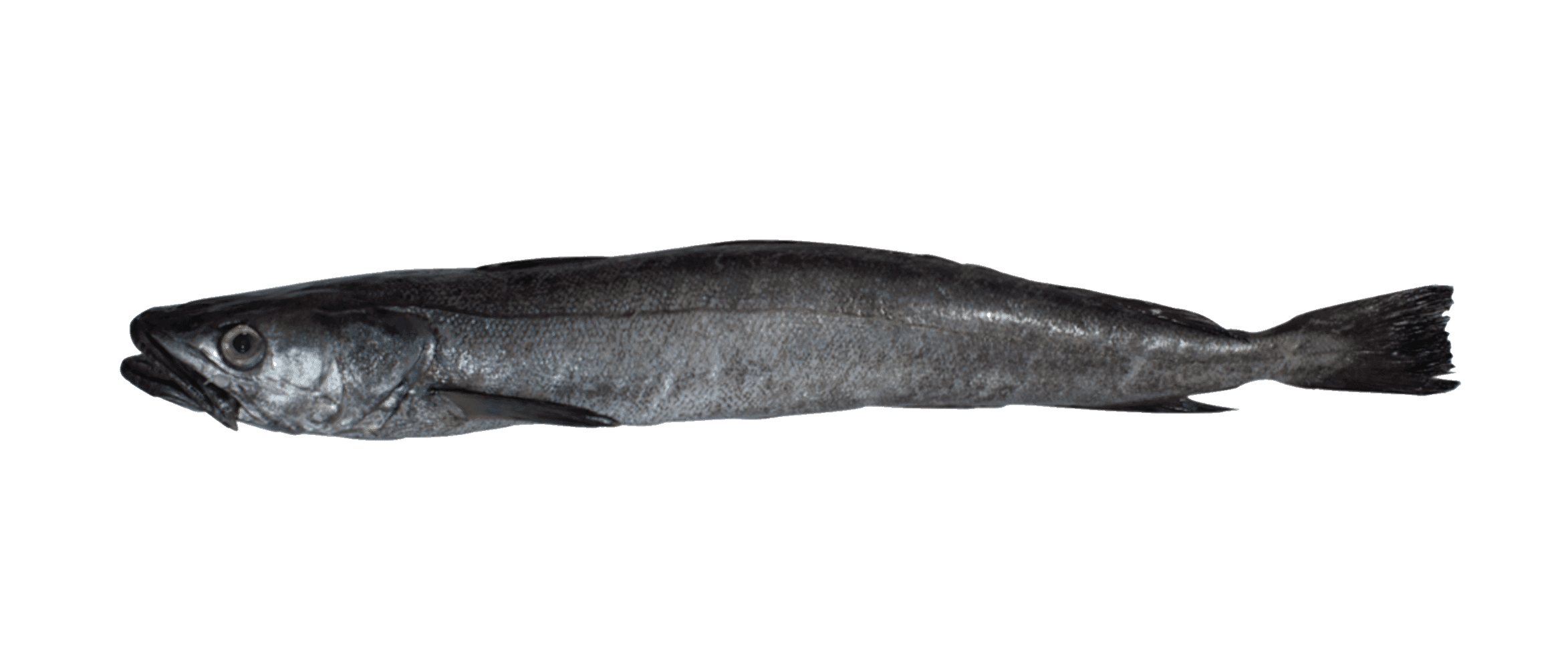
Hake is a marine fish belonging to the Merlucciidae family. It is characterized by a long, slender body, a broad head with a large terminal mouth, and well-developed conical teeth, reflecting its piscivorous diet. Its coloration ranges from silvery gray to light brown on the back; it has silvery sides and a white belly.
It has two dorsal fins (the first short, the second long) and a long anal fin.
Its typical size ranges from 30 to 60 cm.
Its maximum size can reach up to 120 cm.
It is a species that is primarily solitary or lives in small groups, especially among adults.
It has two dorsal fins (the first short, the second long) and a long anal fin.
Its typical size ranges from 30 to 60 cm.
Its maximum size can reach up to 120 cm.
It is a species that is primarily solitary or lives in small groups, especially among adults.
Habitat
The European hake is a demersal to bentho-pelagic species typically found on the continental shelf and slope.
It inhabits muddy or sandy-muddy bottoms.
It is found at depths ranging from 30 to 1,000 m, most commonly between 100 and 400 m.
Its behavior is characterized by daily vertical migrations; it approaches the surface at night to feed and returns to deeper waters during the day.
Juveniles generally occupy more coastal and shallower areas than adults.
It inhabits muddy or sandy-muddy bottoms.
It is found at depths ranging from 30 to 1,000 m, most commonly between 100 and 400 m.
Its behavior is characterized by daily vertical migrations; it approaches the surface at night to feed and returns to deeper waters during the day.
Juveniles generally occupy more coastal and shallower areas than adults.
Distribution
It is an Atlantic-Mediterranean species.
It is found in the northeastern Atlantic from Norway to the Gulf of Guinea, in the English Channel, the southern North Sea, the Bay of Biscay, and the Mediterranean, where it is widely distributed, with higher densities in the western Mediterranean.
It is absent from the western Atlantic.
There are several distinct stocks, managed separately (North Atlantic, South Atlantic, Mediterranean).
It is found in the northeastern Atlantic from Norway to the Gulf of Guinea, in the English Channel, the southern North Sea, the Bay of Biscay, and the Mediterranean, where it is widely distributed, with higher densities in the western Mediterranean.
It is absent from the western Atlantic.
There are several distinct stocks, managed separately (North Atlantic, South Atlantic, Mediterranean).