Shellfish
Great scallop
Pecten maximus
(VIId) Eastern English Channel, (VIIe) Western English Channel
Fishing zones
Wild
Origin
11 cm
Minimum size
Description
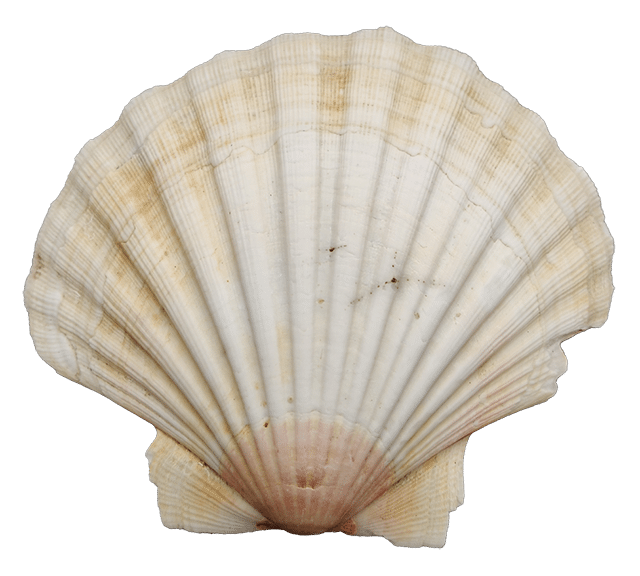
It consists of two very different valves. The right (lower) valve is highly convex and light in color (whitish or cream), while the left (upper) valve is flat and darker in color (reddish-brown or pinkish). The shell has two 'ears' (projections at the hinge) of equal size. It has numerous simple eyes (ocelli) of a brilliant blue color distributed along the edge of its mantle, capable of detecting changes in light and the movements of predators. It is generally 10 to 11 cm in size, but can reach a maximum diameter of 15 to 17 cm.
Habitat
It is a bivalve mollusk that lives on the seafloor (benthic). It prefers clean sandy bottoms, fine gravel, or shell debris. It burrows slightly into a depression that it digs using its convex valve. It is found mainly at depths between 10 and 100 meters, although it can be observed at depths of up to 250 meters.
Distribution
It is a species endemic to the northeastern Atlantic. It is found from northern Norway to the coasts of Morocco and Mauritania. It is particularly abundant in the English Channel (especially in the Bay of Seine and the Bay of Saint-Brieuc), the Irish Sea, and the Bay of Biscay. It is absent from the Mediterranean Sea, where it is replaced by a very closely related species, the Mediterranean scallop (Pecten jacobaeus).