Crustacean
Edible crab
Cancer pagurus
Out of season
—
Fishing zones
Wild
Origin
15 cm (Lcarapace)
Minimum size
Description
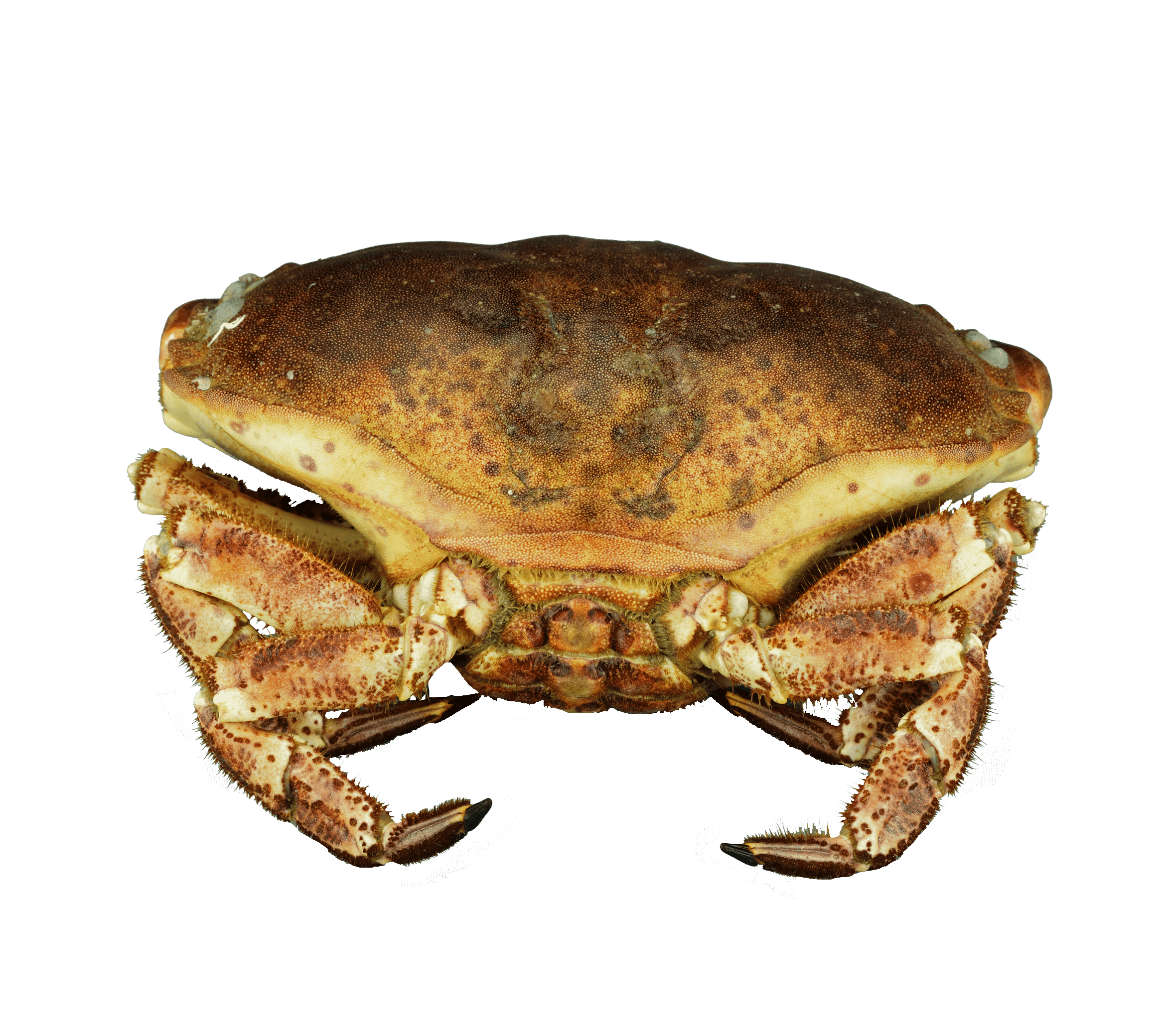
Shell: It is very wide, oval-shaped, and sturdy. Its texture is grainy. The edge of the carapace features characteristic rounded lobes resembling a pie crust. The back is generally reddish-brown or pinkish, while the underside is cream-colored. It has massive, powerful claws. The tips of the claw fingers are deep black, which is a major distinguishing feature of the species. The carapace can reach 25 to 30 cm in width in the largest specimens, with a weight that can exceed 3 kg. It is a predator and a scavenger. It uses its powerful claws to break the shells of mollusks (mussels, barnacles) and the carapaces of other crustaceans.
Habitat
A benthic species (lives on the seafloor). Juveniles are often found in the intertidal zone (under rocks at low tide), while adults prefer deeper waters. It is generally found at depths between 1 and 100 meters, although it can be observed at depths of up to 200 meters. It favors rocky bottoms with crevices to hide in, but it is also found on sandy, gravelly, or muddy bottoms, where it can partially burrow.
Distribution
It is found from northern Norway (as far as the Lofoten Islands) to Morocco. It is very abundant around the British Isles, in the North Sea, and along the coasts of the English Channel and the French Atlantic. It is present but much rarer, mainly in the western basin (the Spanish and French coasts).