
Cephalopod
Common octopus
Octopus vulgaris

(IV) North Sea, (VIId) Eastern English Channel, (VIIe) Western English Channel, (VIIf) Bristol Channel, (VIII) Bay of Biscay
Zones de pêche
Wild
Origine
14,5 cm (Lmanteau)
Taille minimale
Description
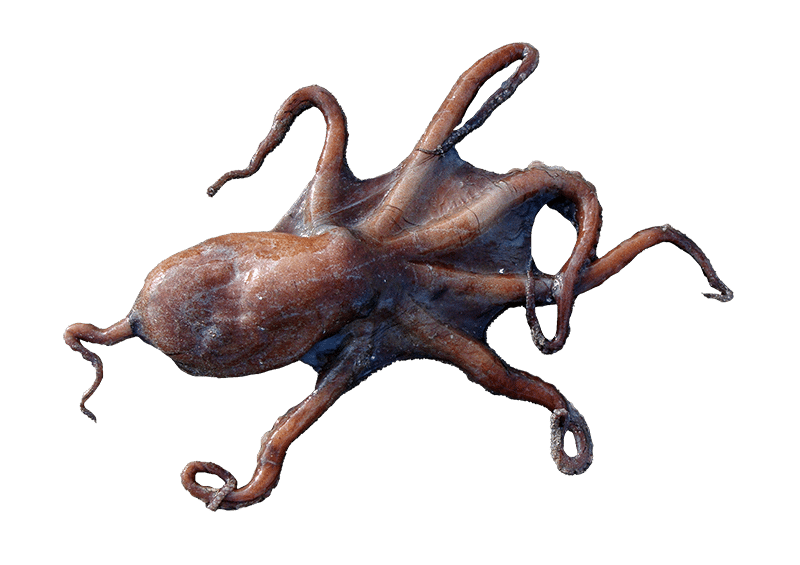
The body is sack-shaped (the mantle) with skin of varying texture (often grainy). It has eight sturdy arms, each equipped with two rows of suction cups. It can instantly change color and texture to blend into its surroundings (camouflage), ranging from reddish-brown to gray or mottled yellow. The mantle can measure up to 25–30 cm, but including the arms, the total length can reach 1 to 1.3 meters. It is an active predator that feeds primarily on crustaceans (crabs, lobsters), mollusks (bivalves, gastropods), and occasionally fish.
Habitat
A benthic species (lives on the seafloor). It is highly opportunistic and inhabits a variety of habitats. It is found from the surface (intertidal zone) down to a depth of about 200 meters, although it is most abundant within the first 100 meters. It lives in "dens" (holes in rocks, crevices, or even man-made objects such as clay pots or tires). Its presence is often indicated by a pile of shell fragments and crab shells.
Distribution
This species has long been considered to have a global distribution, but recent studies suggest it may constitute a species complex. From the coasts of France and the Mediterranean Sea to South Africa. From the coasts of the United States to northern South America. Found in temperate and tropical waters worldwide (although some local populations may be closely related distinct species).