Crustacean
Blue crab
Callinectes sapidus
FAO 37 - Mediterranean and Black Sea
Fishing zone
Wild
Origin
—
Minimum size
Description
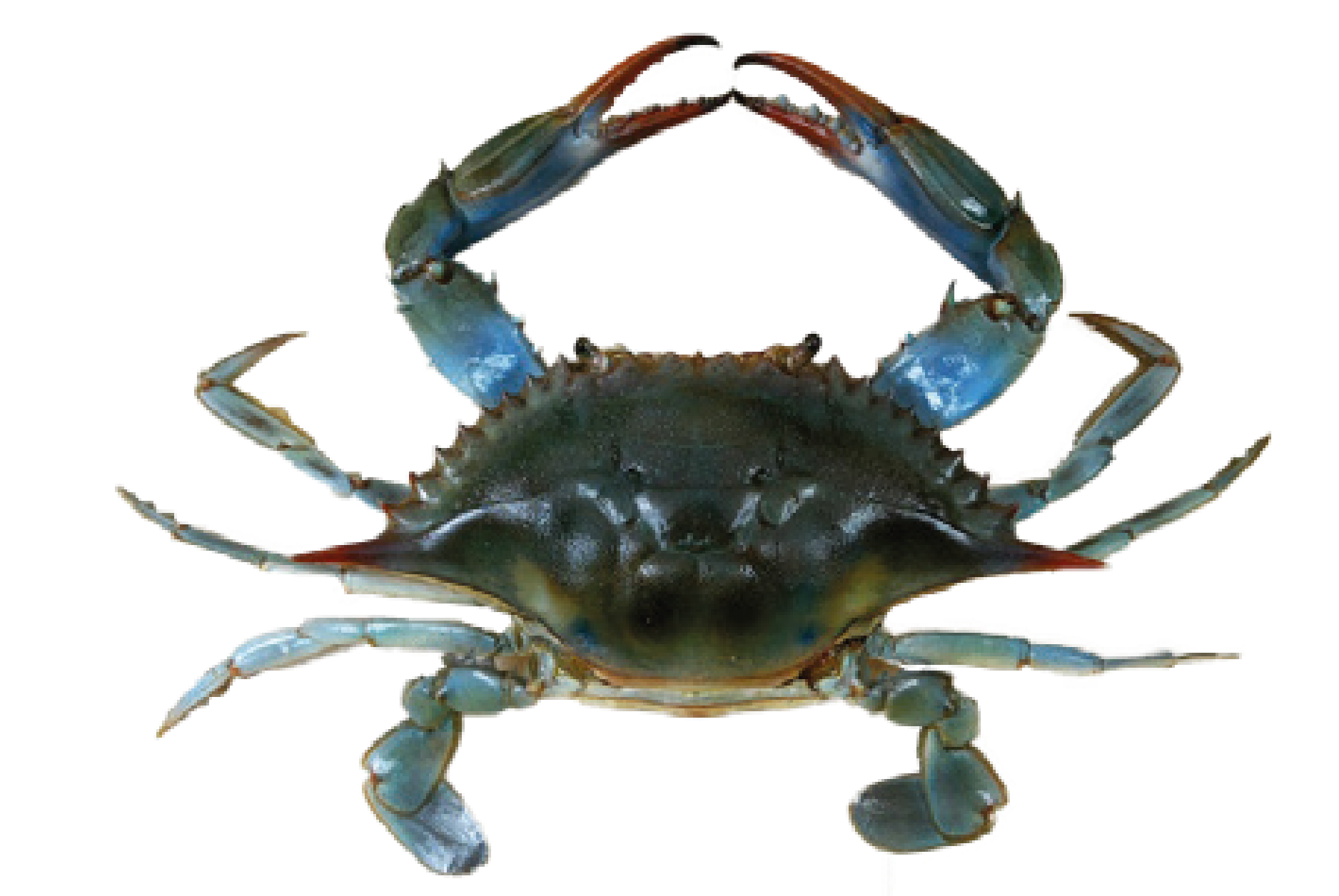
Its carapace is broad and diamond-shaped, with a very long, pointed lateral spine on each side. The anterior edge of the carapace also features a series of small teeth (nine on each side). The claws are robust and of unequal size. In males, they are a bright, vivid blue, while in females, the tips are often tinged with orange-red. The last pair of legs is flattened into a paddle shape, making it an excellent swimmer. The back is generally olive green or brownish, while the belly is whitish. The carapace can reach a width of 20 to 23 cm (including spines).
Habitat
This is a coastal species that prefers shallow waters. It is found mainly in estuaries, brackish lagoons, and sheltered bays. It prefers muddy or sandy bottoms, often near seagrass beds where it can hide. It is extremely tolerant of salinity variations (euryhaline) and can travel far upstream into the nearly freshwater sections of rivers. It generally lives between the surface and a depth of 35 meters, although it may go deeper in winter.
Distribution
Invasive species (Eastern Atlantic and Mediterranean): Introduced accidentally (likely via ship ballast water), it has spread widely. It is now found along European coasts (from the Bay of Biscay to the North Sea), in massive numbers throughout the Mediterranean Sea (Greece, Italy, Tunisia, and increasingly along French coasts such as the Étang de Thau), in the Black Sea, and in Japan.