Fish
Poisson
Atlantic herring
Clupea harengus
(IIIa) Skagerrak and Kattegat, (IV) North Sea, (Va) Icelandic Waters, (VIId) Eastern English Channel
Fishing zones
Wild
Origin
24 cm
Minimum size
Description
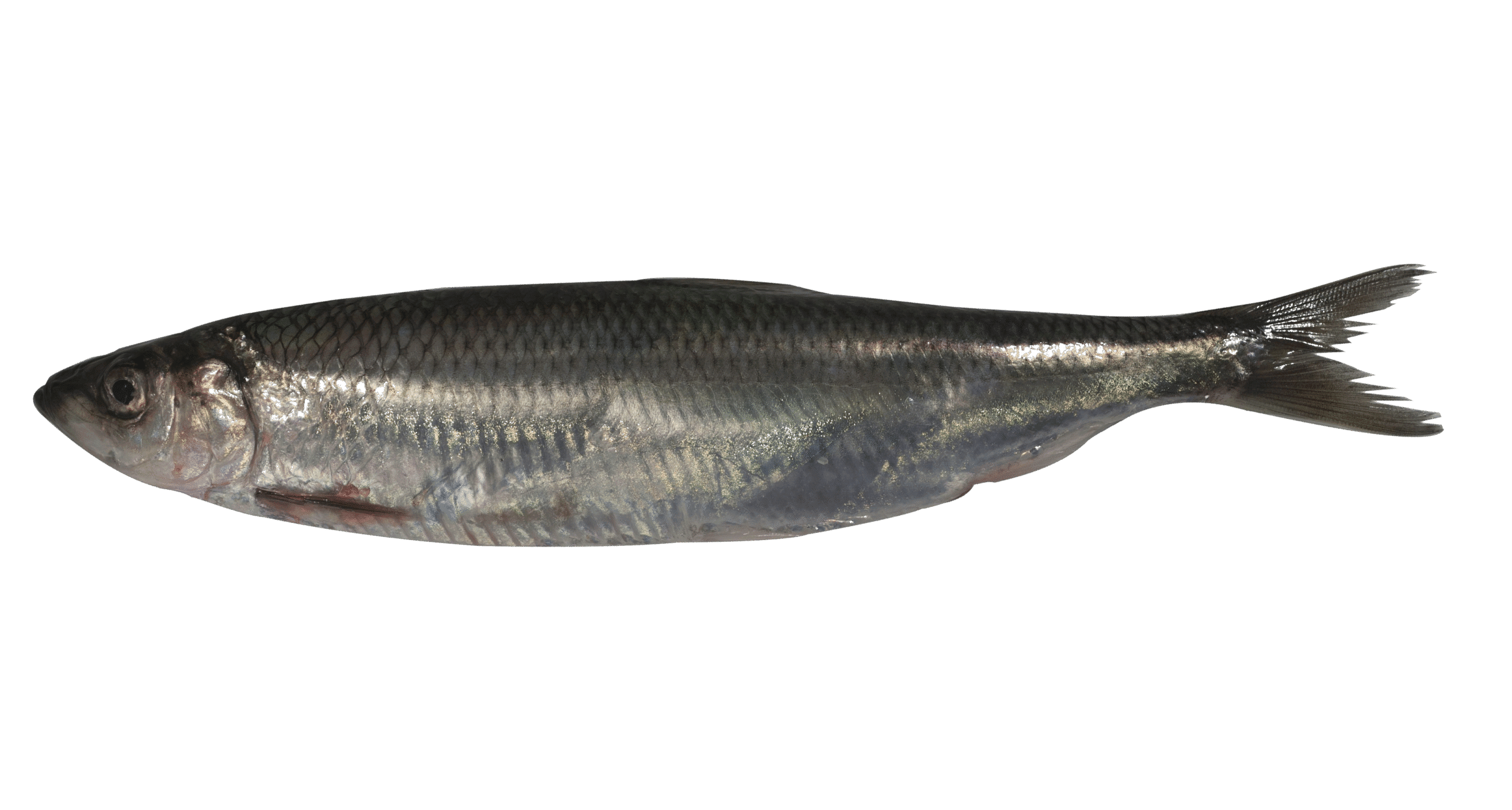
Its body is elongated, spindle-shaped, and laterally compressed. Its lower jaw is slightly more prominent than the upper jaw. It has cycloid (smooth) scales that come off very easily. The belly lacks a sharp keel, unlike other Clupeidae such as the shad. The dorsal fin is located approximately in the middle of the body. It lacks a visible lateral line on its flanks. The back is a deep blue-green or steel blue, while the flanks and belly are a shiny silvery white. Its average size is 25 to 30 cm, but it can reach a maximum of 45 cm at ages exceeding 20 years.
Habitat
It is a pelagic fish that lives in huge, compact schools (which can number several million individuals). It undertakes significant migrations between its feeding grounds in the open sea and its spawning grounds near the coast. It also engages in diurnal vertical migrations: it remains at depth during the day and rises to the surface at night to feed on plankton. It is generally found between the surface and a depth of 200 meters. It feeds mainly on small copepod crustaceans, fish larvae, and tiny planktonic organisms, which it filters through its gill rakers.
Distribution
It is extremely abundant in the North Sea, the Baltic Sea (where a smaller subspecies lives), the Norwegian Sea, and the English Channel.