The word “cephalopod” comes from the Ancient Greek words *képhalé*, meaning “head,” and *pous*, meaning “foot”; these are animals with feet on their heads, specifically tentacles.
This class within the phylum Mollusca includes octopuses, cuttlefish, squid, and nautiluses.
Although very similar, these species each have their own distinct characteristics.
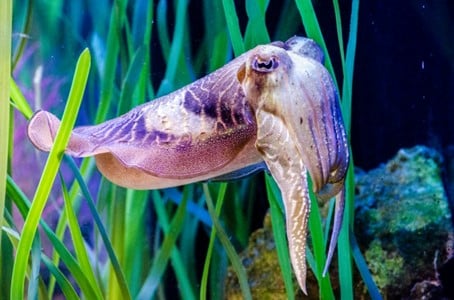
Cuttlefish and squid have soft bodies and tentacles with suction cups. They feed mainly on fish, crustaceans, and other mollusks, which they capture using their arms.
Their unique defense mechanism allows them to blend into their surroundings. They are able to change the texture and color of their bodies to camouflage themselves and thus defend against predators.
Although both have 10 tentacles, the cuttlefish has two longer ones, whereas in the squid, they are all of different lengths. The squid has an internal shell, called a “plume,” which supports its organs and muscles. Unlike the cuttlefish, it also has an external shell made of calcium carbonate.
The cuttlefish has an internal calcified structure, the sepion, better known as the “cuttlefish bone”; it serves the same function as the pen in the squid.
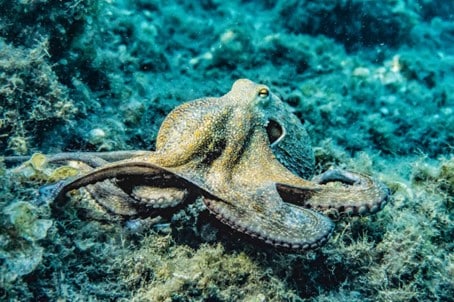
The octopus and the common octopus are in fact one and the same animal; the only difference between these two terms is their historical usage, with the name “octopus” deriving from the Greek root “polypous,” meaning “many feet.” Octopuses are known as the most evolved of the mollusks, endowed with great intelligence. Like their cousins, they are equally capable of camouflaging themselves in their environment.
Cephalopods are widely known for squirting ink. This is a defense mechanism against any threats. The ink’s darkness is due to the presence of a pigment called melanin. The opaque cloud allows them, among other things, to flee and thus escape predators.
These cephalopods are cooked all over the world, particularly in traditional dishes. They can be prepared in various ways, from grilled to boiled.