Fish
Poisson
Red mullet
Mullus barbatus
(GSA10) Central and Southern Tyrrhenian Sea
Fishing zone
Wild
Origin
14 cm
Minimum size
Description
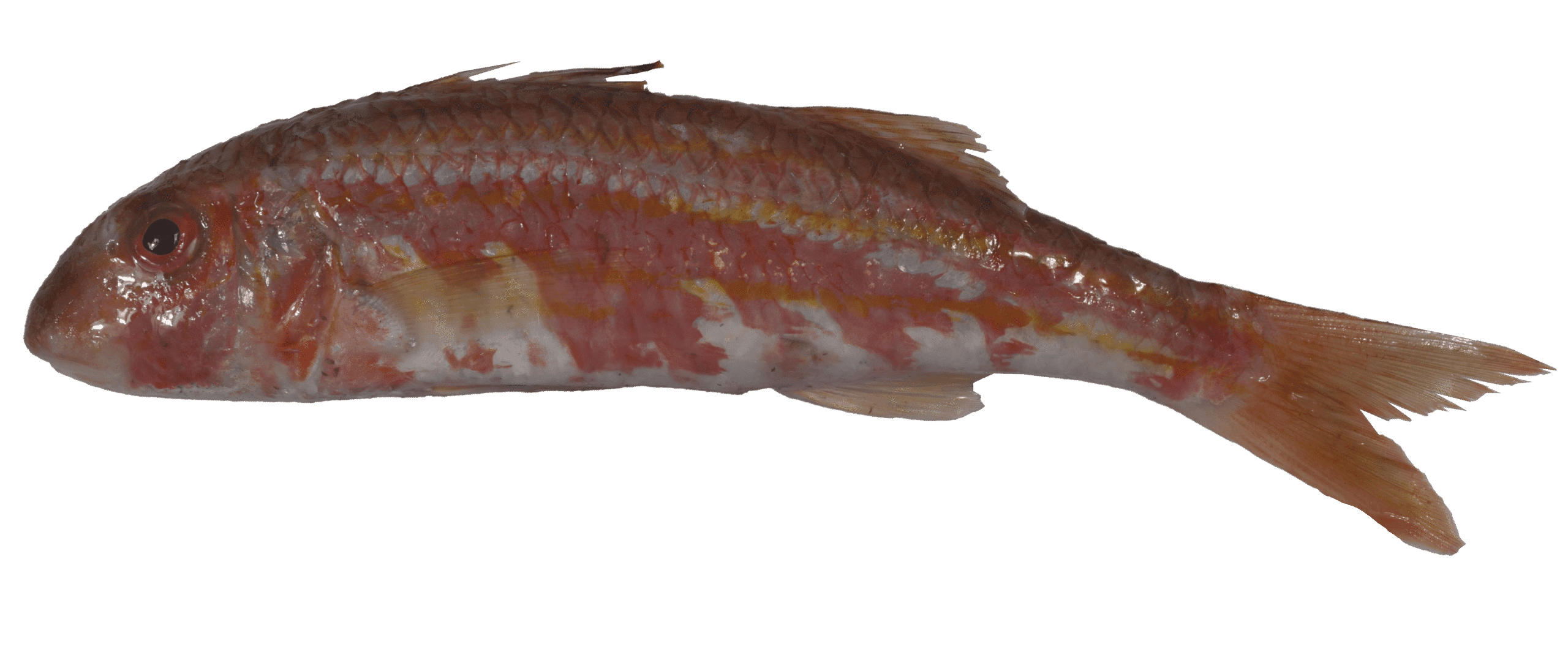
The body is elongated and laterally compressed. The profile of the snout is very steep (almost vertical), which distinguishes it from the red mullet (Mullus surmuletus). It has a pair of robust barbels under the chin, which are essential for sifting through sediment. These barbels are generally shorter than the pectoral fins. The body is pinkish-red to orange on the back and sides, lightening toward the silvery belly. Unlike the red mullet, its fins lack distinct dark colored bands. The typical size ranges from 10 to 20 cm, but it can reach a maximum recorded length of 38,2 cm. The upper jaw is toothless in adults, but it has teeth on the lower jaw and on the palate. Carnivorous, it uses its sensory barbels to detect prey in the sediment. Its diet consists mainly of small benthic invertebrates: polychaete worms, bivalve mollusks, and small crustaceans.
Habitat
A demersal (bottom-dwelling) and gregarious (schooling) marine species. It prefers the soft, muddy bottoms of the continental shelf, but is also found on sandy and gravelly substrates. It typically inhabits depths ranging from 10 to 328 meters, although it is most commonly found between 100 and 300 meters.
Distribution
From Scandinavia and Norway to Senegal, including the Canary Islands, the Azores, and Madeira. Very common throughout the Mediterranean Sea and the Black Sea.