Shellfish
Farmed European abalone
Haliotis tuberculata
—
Fishing zones
Livestock farming
Origin
—
Minimum size
Description
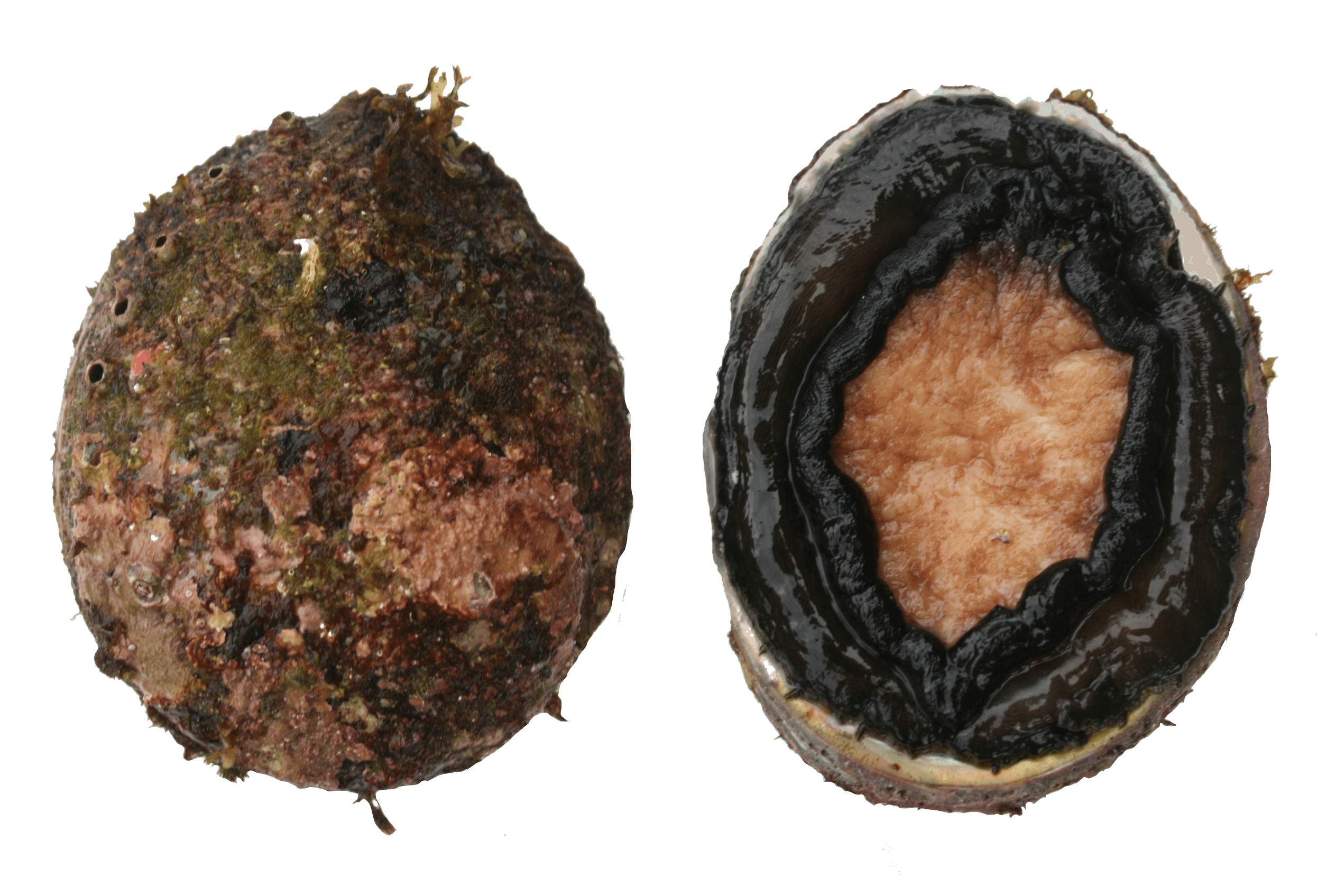
The abalone shell is ear-shaped, oval, and flattened. The surface is rough with tubercles. It features a row of 5 to 7 open pores along the edge of the shell, which allow water and waste to be expelled. Its external color is highly variable (often brown, green, or reddish for camouflage), but the interior is lined with a very shiny, iridescent mother-of-pearl. In aquaculture, they are often sold at around 5 to 7 cm, but in the wild, they can reach 10 to 12 cm. A strict herbivore, it feeds on red and brown algae. In aquaculture, abalones are fed either with fresh, locally harvested seaweed (Laminaria) or with specialized pellets.
Habitat
A benthic species living on rocky bottoms. It is found primarily in the intertidal zone (the area affected by the tides) and in the infralittoral zone. From the surface down to a depth of about 20–25 meters. It attaches itself firmly to rocks using its broad, muscular foot. It is a light-shy animal that hides under rocks or in crevices during the day.
Distribution
From the English Channel (bordering the Channel Islands and Brittany to the north) to Senegal. Found throughout the Mediterranean Sea. In France, aquaculture farms are mainly located in Brittany (Finistère and Côtes-d'Armor), where the waters are rich in algae and well-oxygenated.