Shellfish
Farmed Mediterranean mussel
Mytilus galloprovincialis
—
Fishing zones
Livestock farming
Origin
—
Minimum size
Description
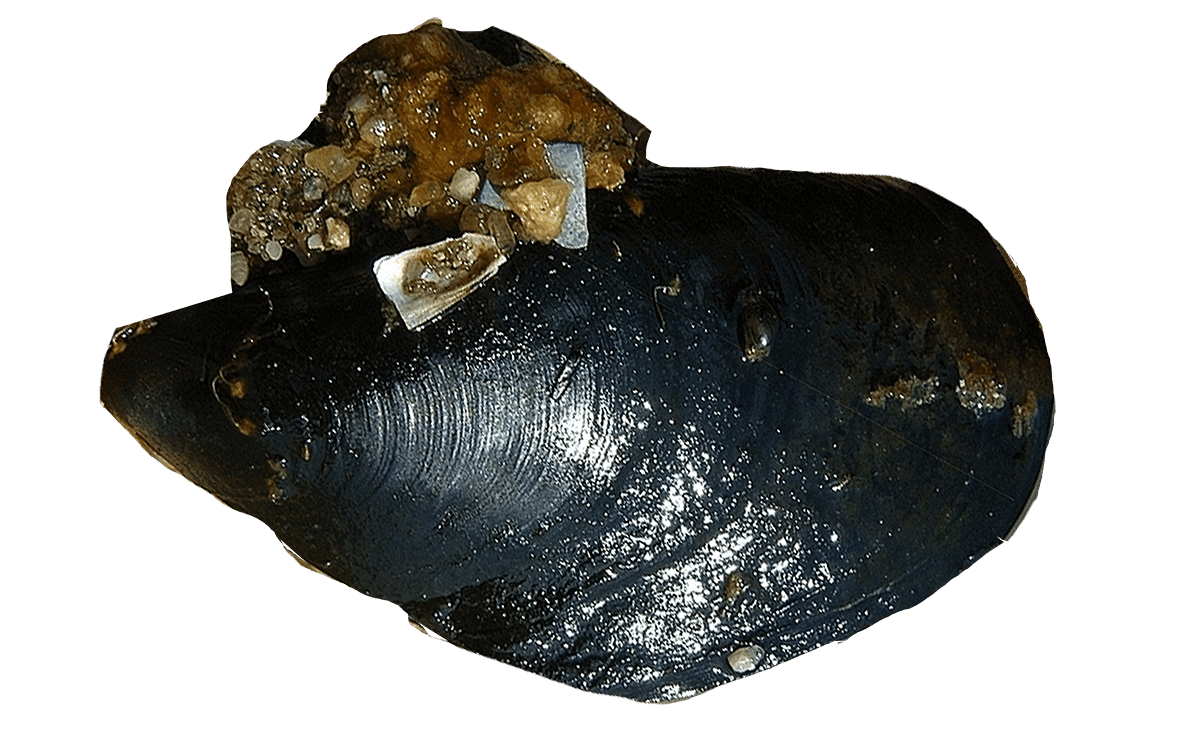
It is a bivalve mollusk with a sturdy shell that is oblong or nearly square in shape, pointed at the front (umbus) and widened at the back. The exterior is dark blue-violet, black, or dark brown. The interior is a pearly bluish-white with a mantle edge that is often dark purple. It generally measures about 5 to 8 cm in aquaculture, but can reach a maximum size of 14 to 15 cm in the wild. It differs from its cousin, the common mussel (Mytilus edulis), in its taller shape and more domed valves.
Habitat
It lives primarily in the intertidal zone (the area affected by tidal fluctuations) and in shallow subtidal areas (down to about 40 meters). It is a sessile species that attaches itself firmly to rocks, harbor structures, or aquaculture ropes using its byssal threads. It prefers temperate waters and tolerates variations in salinity well, allowing it to thrive in lagoons and estuaries. It is a filter feeder and feeds on phytoplankton and suspended organic matter.
Distribution
Native to the Mediterranean and Black Seas, as well as the Atlantic coasts of southern Europe (particularly Galicia in Spain). Due to its hardiness and aquaculture practices, it has spread widely. It is now found on the west coast of North America, in Japan, South Africa, and Australia. Mussel farming: It is the dominant species in aquaculture in the Mediterranean (e.g., Étang de Thau in France, Italy, Greece) and along the Spanish Atlantic coast (Rías Baixas).