Algae
Sugar kelp
Laminaria saccharina
(VIIIa) Bay of Biscay - North, (VIIIb) Bay of Biscay - Central
Fishing zones
Wild
Origin
150 cm
Minimum size
Description
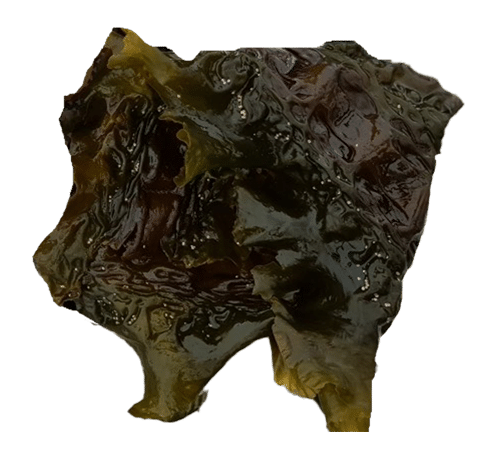
It is a large brown seaweed consisting of a holdfast (anchor), a short cylindrical stipe (stem), and a single frond (leaf). The frond is long and ribbon-like, with wavy or crinkled edges. It lacks a central vein, which distinguishes it from the Alariaceae family. Its surface is often dotted with small blisters. It is rich in mannitol, a natural sugar that can appear as a thin white film when the seaweed dries (hence its name "sugared"). It can reach a length of 2 to 4 meters, with a width of 15 to 20 cm.
Habitat
It lives attached to hard substrates in the infralittoral zone. It is found on rocks, stones, or even occasionally on large shells, in areas that are sheltered or moderately exposed to currents. It prefers cold, nutrient-rich waters. It can tolerate lower salinity, allowing it to thrive at the mouths of fjords or estuaries. From the lower tidal limit (lower foreshore) down to a depth of about 20 to 30 meters, depending on the water clarity required for photosynthesis.
Distribution
Very common along the coasts of Europe, from the Arctic and Norway down to Portugal (less common further south). It is also found along the eastern coast of North America (from Greenland to New Jersey).