Fish
Poisson
Haddock
Melanogrammus aeglefinus
(IIIa) Skagerrak and Kattegat, (IV) North Sea, (Va) Icelandic Waters, (VI) Rockall and West of Scotland
Fishing zones
Wild
Origin
46 cm
Minimum size
Description
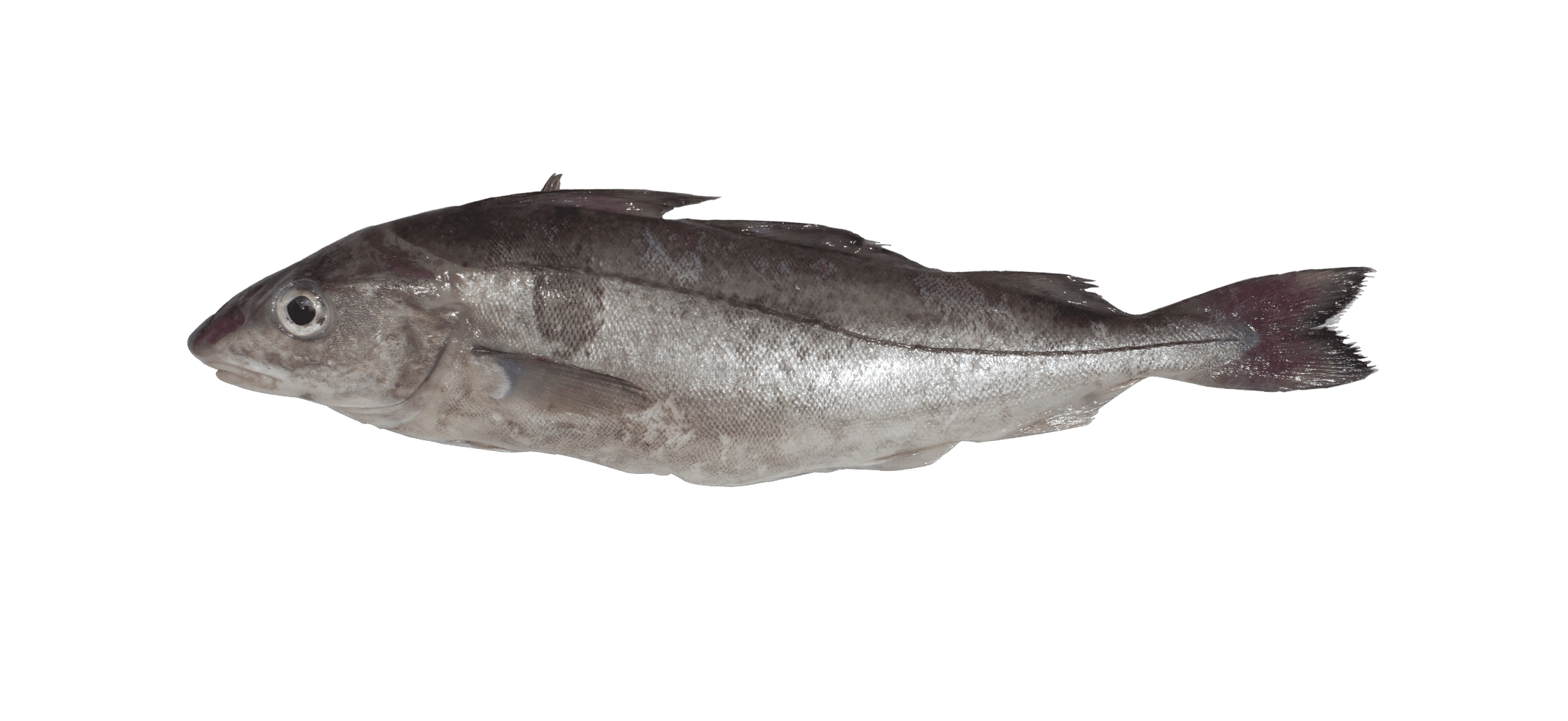
It has an elongated, spindle-shaped body with three dorsal fins and two distinct anal fins (a characteristic of Gadidae, such as cod). Its upper jaw extends slightly beyond the lower jaw, and it has a small chin barbels. The lateral line is black and clearly defined, extending from the gill cover to the tail. Its most famous feature is a large black spot located above the pectoral fin, often called the Saint-Pierre thumb mark. The back is gray-violet or dark olive, the sides are silvery gray, and the belly is pure white. Its typical size ranges from 35 to 70 cm, but it can reach a maximum length of 1.10 meters and weigh nearly 17 kg.
Habitat
It is a demersal fish that lives above the continental shelf. It prefers sandy, gravelly, or crushed-shell bottoms. Unlike cod, it generally avoids bottoms consisting solely of mud. It is found mainly between 40 and 150 meters, but it can descend to depths of up to 300 meters. Juveniles prefer shallower waters than adults. It feeds primarily on small bottom-dwelling invertebrates (crustaceans, mollusks, echinoderms) and occasionally on small fish.
Distribution
It is found exclusively in the North Atlantic. Its range extends from Spitsbergen and the Barents Sea in the north to the Bay of Biscay in the south. It is extremely abundant around Iceland, the British Isles, and in the North Sea. It is found from Greenland to Cape Hatteras (United States). It is absent from the Mediterranean Sea.