Shell
Razor clam
Ensis sp
Out of season
—
Fishing zones
Wild
Origin
10 cm
Minimum size
Description
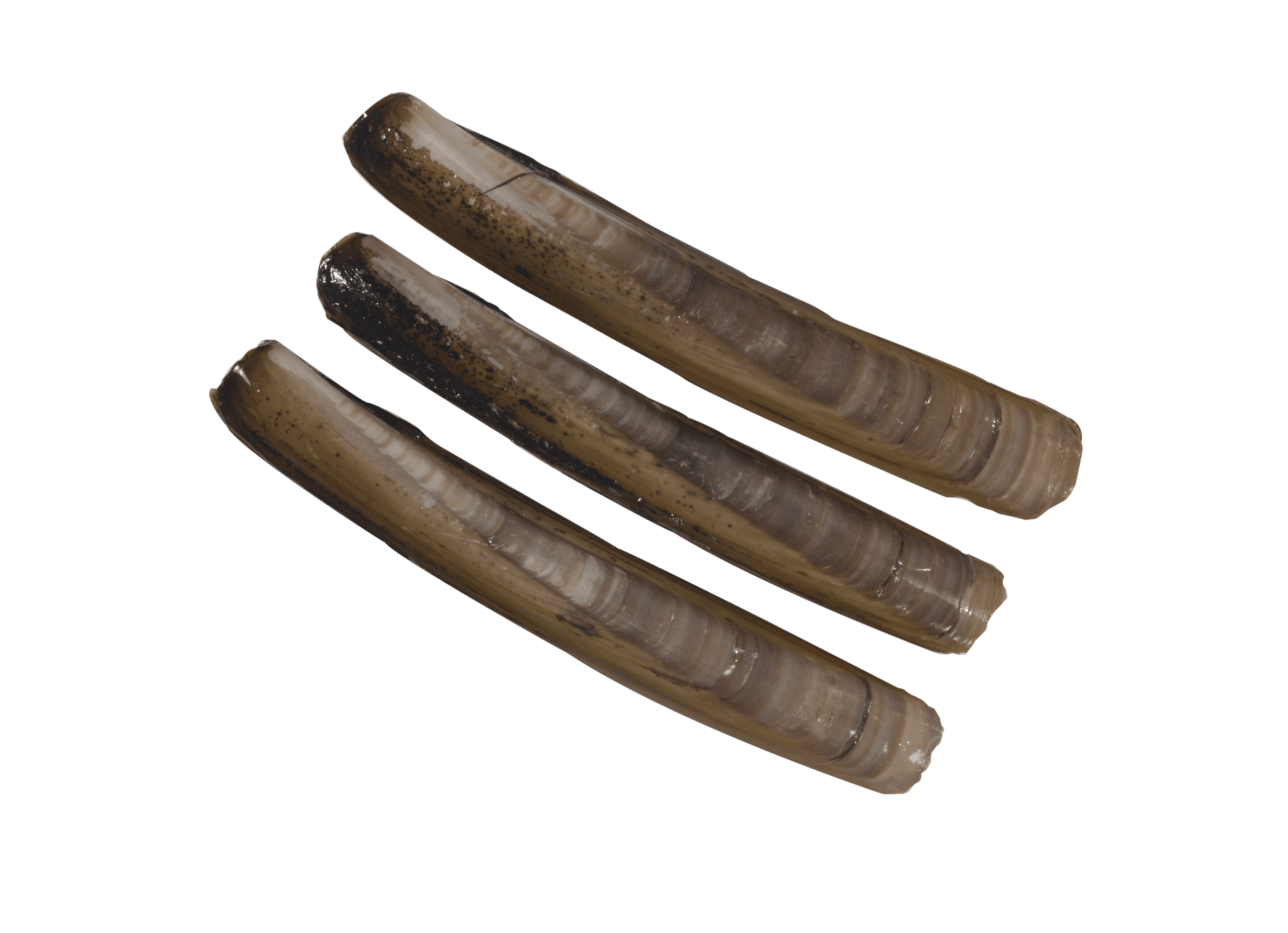
Its shell is very elongated, narrow, and straight (or slightly arched, depending on the species). The two valves are symmetrical and open at both ends. The surface is smooth, covered with a shiny periostracum (protective layer) ranging in color from greenish-yellow to olive brown. It resembles the handle of an old-fashioned razor, hence its English name. The razor clam has an extremely powerful muscular foot at the lower end, which allows it to burrow vertically into the sand at surprising speed. Depending on the species, its length generally ranges from 10 to 23 cm.
Habitat
This is a benthic endofaunal species (living within the sediment). It lives exclusively in fine sand or silty sand, where it digs deep vertical burrows. It is found mainly in the intertidal zone (lower beach) and in the infralittoral zone down to a depth of about 20 to 30 meters. The razor clam is very sensitive to vibrations. When danger threatens, it retreats deep into its burrow. Its presence is often revealed at low tide by a small hole shaped like a keyhole or a figure 8 in the wet sand.
Distribution
Species of the genus Ensis are found in the temperate regions of the North Atlantic, as well as locally in the Mediterranean.