Fish
Poisson
Witch flounder
Glyptocephalus cynoglossus
(IIIa) Skagerrak and Kattegat, (IV) North Sea, (VIId) Eastern English Channel
Fishing zones
Wild
Origin
30 cm
Minimum size
Description
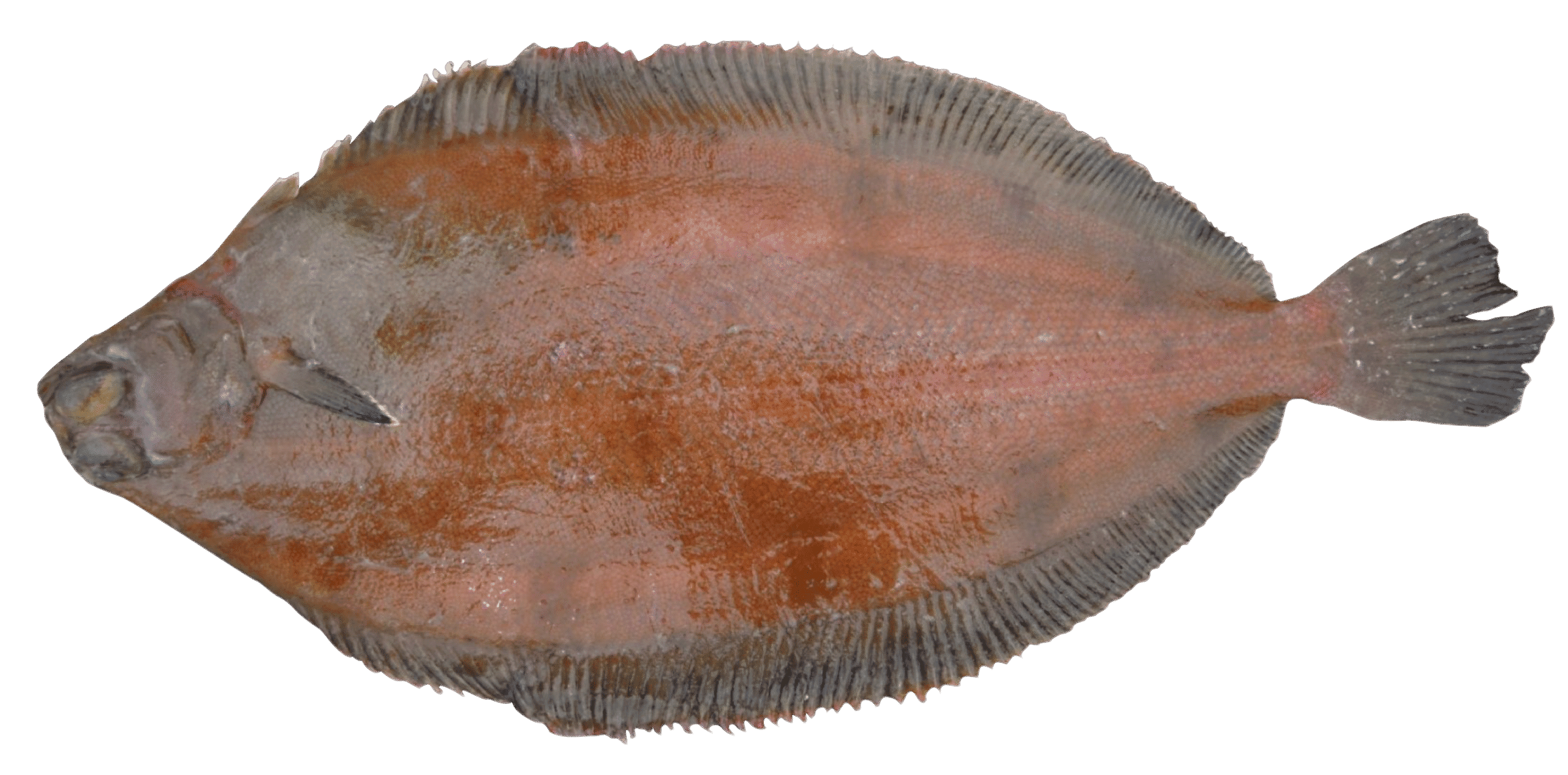
It is a notably elongated and thin flatfish. Both eyes are located on the right side of the head. The mouth is small. The eyed side is uniform greyish-brown to olive-brown, often with dark spots, while the blind side is opaque white to greyish, peppered with tiny black dots. Its skin is remarkably smooth to the touch. It usually measures between 30 and 45 cm, but can reach a maximum length of 60 cm.
Habitat
The witch flounder is a marine, benthic (bottom-dwelling) fish. It strictly prefers cold, deep waters. It is typically found on soft bottoms consisting of fine mud, muddy sand, or clay, at depths ranging from 18 to 1,570 meters, though it is most common between 150 and 600 meters.
Due to its small mouth, it feeds on small benthic prey. Its diet consists primarily of polychaete worms, small crustaceans (amphipods, shrimps), small mollusks, and occasionally small fish or echinoderms (brittle stars).
Due to its small mouth, it feeds on small benthic prey. Its diet consists primarily of polychaete worms, small crustaceans (amphipods, shrimps), small mollusks, and occasionally small fish or echinoderms (brittle stars).
Distribution
The species is widely distributed throughout the North Atlantic:
Northwest Atlantic: From Greenland and Labrador (Canada) south to North Carolina (USA).
Northeast Atlantic: From the Barents Sea and Norway south to the Bay of Biscay, including the North Sea and Iceland. It is absent from the Mediterranean Sea.
Northwest Atlantic: From Greenland and Labrador (Canada) south to North Carolina (USA).
Northeast Atlantic: From the Barents Sea and Norway south to the Bay of Biscay, including the North Sea and Iceland. It is absent from the Mediterranean Sea.