Crustacean
Velvet swimming crab
Necora puber
(IV) North Sea, (VIId) Eastern English Channel
Fishing zones
Wild
Origin
4,5 cm
Minimum size
Description
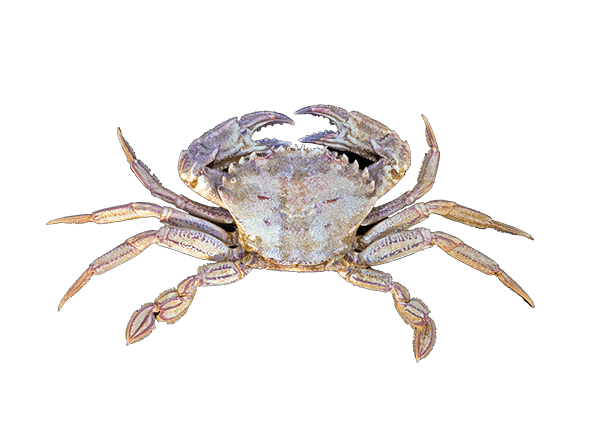
It has a slightly trapezoidal shape, being wider than it is long. Its most distinctive feature is that it is covered with a downy layer of short, dense hairs, giving it a velvety texture to the touch. Its eyes are a very distinctive bright red, which is why it is sometimes nicknamed the devil crab. Like all crabs in the Portunidae family, the last pair of legs is flattened into a paddle-like shape, allowing it to swim efficiently. Between the eyes, the edge of the carapace features 8 to 10 teeth of varying sizes. The carapace is generally 7 to 10 cm wide.
Habitat
This is a very active and fast-moving benthic crab, known for its aggressiveness. It lives mainly on rocky bottoms, scree, and areas rich in seaweed. It prefers crevices where it can hide. It is found from the intertidal zone (under rocks at low tide) down to depths of about 70 to 80 meters. It is an opportunistic predator that feeds on small crustaceans, mollusks, and algae. It is capable of swimming short distances to escape a predator or capture prey.
Distribution
It is widespread in the northeastern Atlantic. Its range extends from southern Norway to Western Sahara (Mauritania). It is extremely common along the coasts of the English Channel, the North Sea, and the Atlantic (Brittany, Bay of Biscay). It is present but much rarer, mainly found in the western basin (Alboran Sea, Spanish coast).