Fish
Streaked gurnard
Trigloporus lastoviza
Hors saison
—
Zones de pêche
Wild
Origine
20 cm
Taille minimale
Description
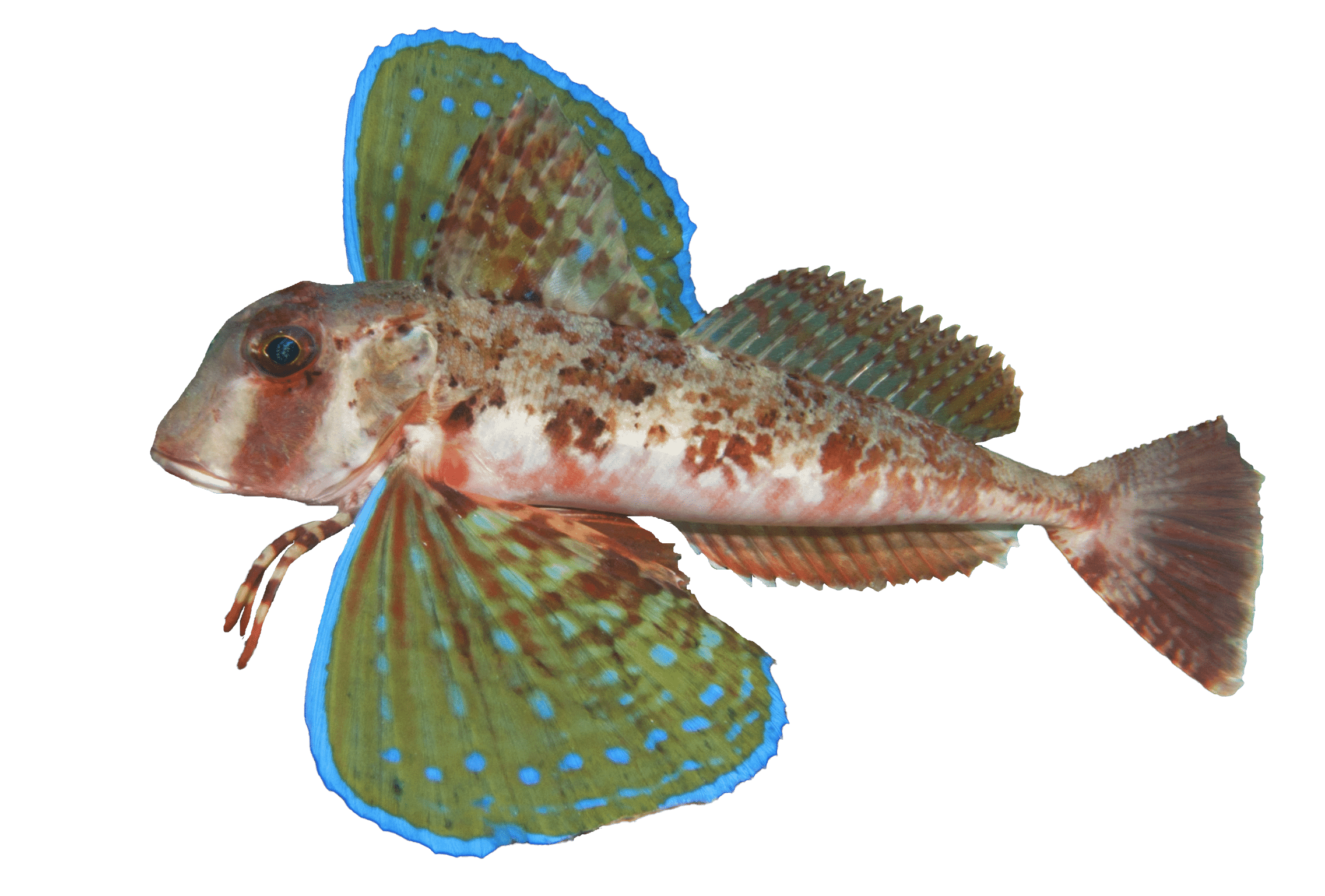
Like all gurnards, it has a massive head, reinforced by bony plates, and a very short, snub-nosed snout (hence its name). Its most distinctive feature is the presence of numerous tight, transverse skin folds running the length of its flanks, giving it a 'wrinkled'cor 'striped' appearance. These folds are very wide, resembling wings. They are generally dark in color (blue-black) with bright, iridescent blue spots along the edges and on the underside. The first three rays of its pectoral fins are free and jointed, resembling 'fingers' that allow it to 'walk' along the seabed and detect its prey. The body is bright red or orange, sometimes mottled with brown on the back, while the belly is white. Its average size is 20 to 25 cm, but it can reach a maximum length of 40 cm.
Habitat
It is a benthic fish (lives on the seafloor). It prefers sandy, gravelly, or shell-littered bottoms, but can also be found on rocky bottoms or near seagrass beds. It is a solitary fish that uses its free rays to sift through the sediment in search of small crustaceans and mollusks. It is known to emit grunts (vibrations of the swim bladder) when stressed or out of the water. It is generally found between 10 and 40 meters, but it can descend to depths of up to 150 meters.
Distribution
It is found from the coasts of southern Norway and the British Isles all the way to South Africa, including the Azores, Madeira, and the Canary Islands. It is very common throughout the Mediterranean basin. In France, it is frequently found in the English Channel, the Atlantic, and the Mediterranean.