Cephalopod
Musky octopus
Eledona muschata
(GSA7) Gulf of Lion, (GSA8) Corsica, (VIIf) Bristol Channel, (VIIg) Northern Celtic Sea, (VIIh) Southern Celtic Sea, (VIII) Bay of Biscay
Fishing zones
Wild
Origin
9,5 cm - Longueur manteau
Minimum size
Description
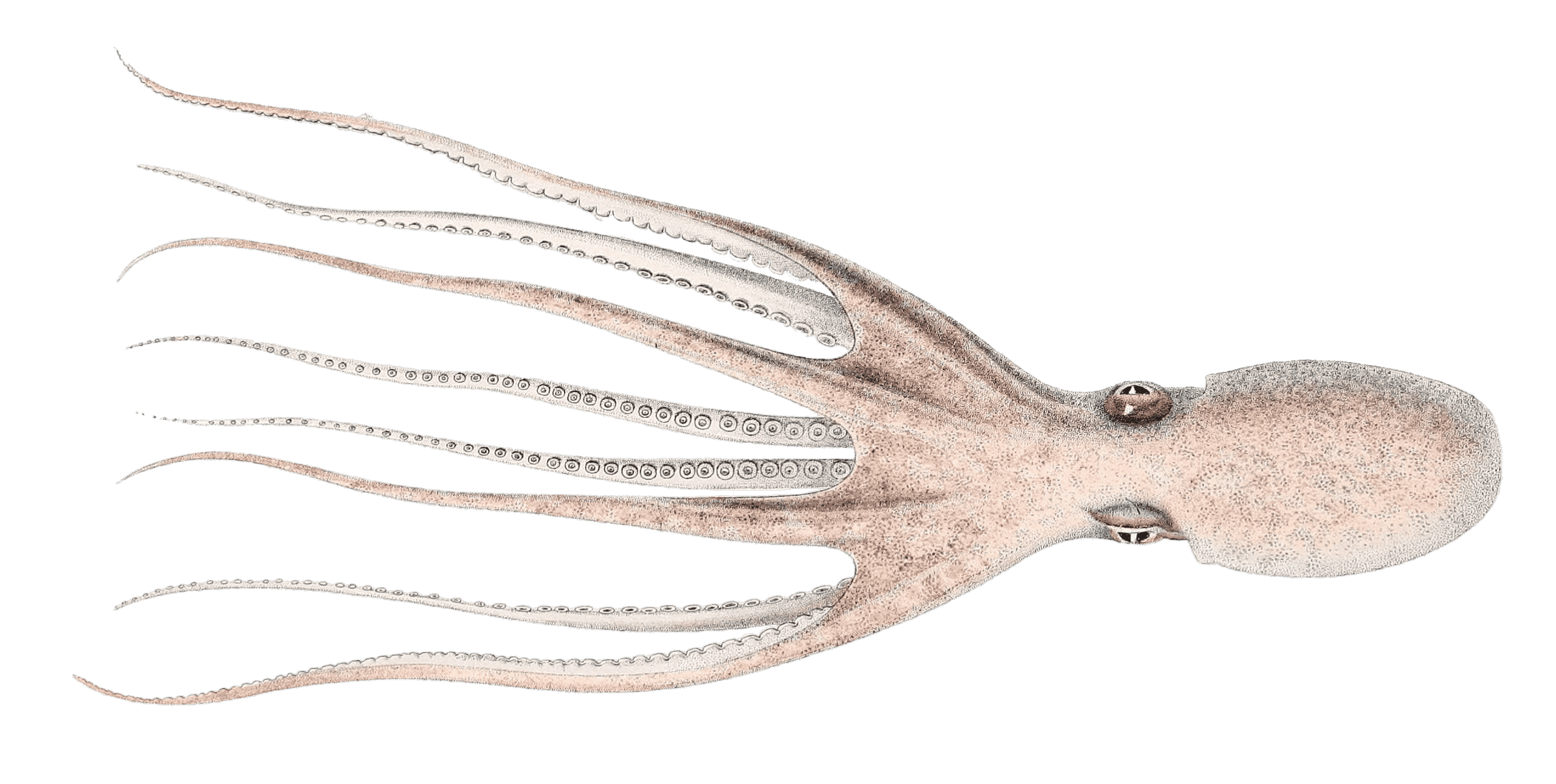
Like all octopods, it has eight arms. However, the genus Eledone differs from the genus Octopus in that it has a single row of suction cups on each arm (compared to two in the common octopus). Its skin is smooth with small, scattered granules. It has a fairly well-developed membrane (umbrella) between its arms. Its name comes from the characteristic musky odor it emits when freshly caught. It is generally grayish, brownish, or ochre in color with irregular dark spots (often blackish or dark brown) on its back. Its mantle measures about 15 cm, with a total length (including arms) that can reach 35 to 40 cm.
Habitat
It is a benthic species that lives primarily on the continental shelf. It prefers soft substrates, such as mud or sandy mud, but can also be found on detrital substrates. It is generally found at depths between 10 and 150 meters, although it can descend to depths of up to 300 meters. It is a nocturnal predator that feeds mainly on crustaceans (crabs, shrimp) and small fish or mollusks.
Distribution
The musk dolphin is a species found almost exclusively in the Mediterranean. It is present throughout the Mediterranean Sea basin, from the Alboran Sea to the Aegean Sea, as well as in the Adriatic Sea. Its presence is very limited and confined to the immediate vicinity of the Strait of Gibraltar (coasts of Morocco and Andalusia). It is absent from the cold waters of the North Atlantic, where it is replaced by the white-winged scoter (Eledone cirrhosa).