Fish
Poisson
Megrim
Lepidorhombus whiffiagonis
(GSA7) Gulf of Lion, (GSA8) Corsica, (IVa) Northern North Sea, (IXa) Portuguese Waters - East, (VIa) Northwest Coast of Scotland and Northern Ireland, (VIb) Rockall, (VIIIa) Bay of Biscay - North, (VIIIb) Bay of Biscay - Central, (VIIIc) Bay of Biscay - South
Fishing zones
Wild
Origin
28 cm - 27 cm
Minimum size
Description
28 cm in the Northeast Atlantic and 27 cm in the Mediterranean.
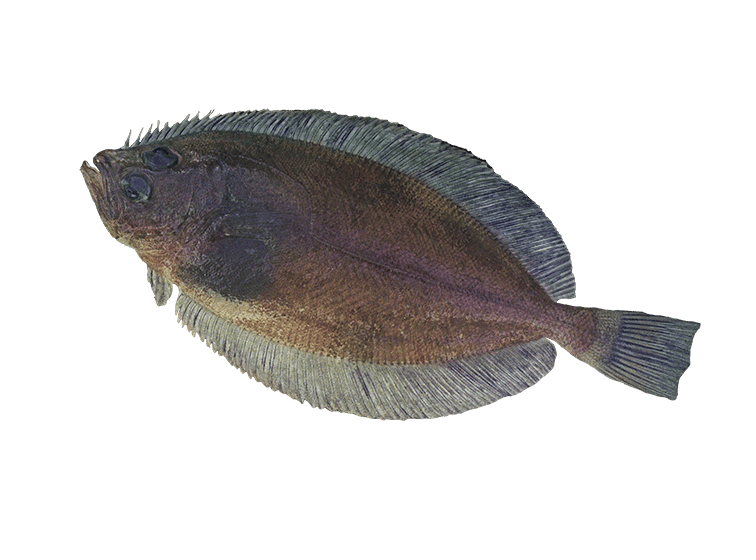
Its eyes are on the left side. Its body is very elongated, oval-shaped, and extremely slender, almost translucent in smaller individuals. Its mouth is very large and oblique, with a protruding lower jaw. The eyes are large and close together, separated by a narrow bony ridge. The ocellated (visible) side is a fairly uniform yellowish-brown or sandy-gray. Unlike L. boscii, it lacks the four distinct black spots on the posterior fins, although it may exhibit some diffuse mottling. The common cardine is larger than the four-spot cardine. Its typical size is 25 to 40 cm, but it can reach 60 cm.
Its eyes are on the left side. Its body is very elongated, oval-shaped, and extremely slender, almost translucent in smaller individuals. Its mouth is very large and oblique, with a protruding lower jaw. The eyes are large and close together, separated by a narrow bony ridge. The ocellated (visible) side is a fairly uniform yellowish-brown or sandy-gray. Unlike L. boscii, it lacks the four distinct black spots on the posterior fins, although it may exhibit some diffuse mottling. The common cardine is larger than the four-spot cardine. Its typical size is 25 to 40 cm, but it can reach 60 cm.
Habitat
A bottom-dwelling (demersal) fish that lives on continental shelves and slopes. It particularly favors muddy and fine-sand bottoms. It is generally found between 100 and 400 meters, but can descend to depths of 600–700 meters. It is an active predator that feeds mainly on small benthic fish (such as dragonfish), shrimp, and cephalopods.
Distribution
It is widespread in the northeastern Atlantic. It is found from northern Norway and Iceland to Cape Bojador (Western Sahara). It is very common in the North Sea, around the British Isles, and in the Bay of Biscay. It is also present in the Mediterranean Sea (mainly in the western basin), but is less abundant there than its four-spot cousin.