Fish
Poisson
Lyre-mouthed goby
Trigla lyra
Out of season
—
Fishing zones
Wild
Origin
25 cm
Minimum size
Description
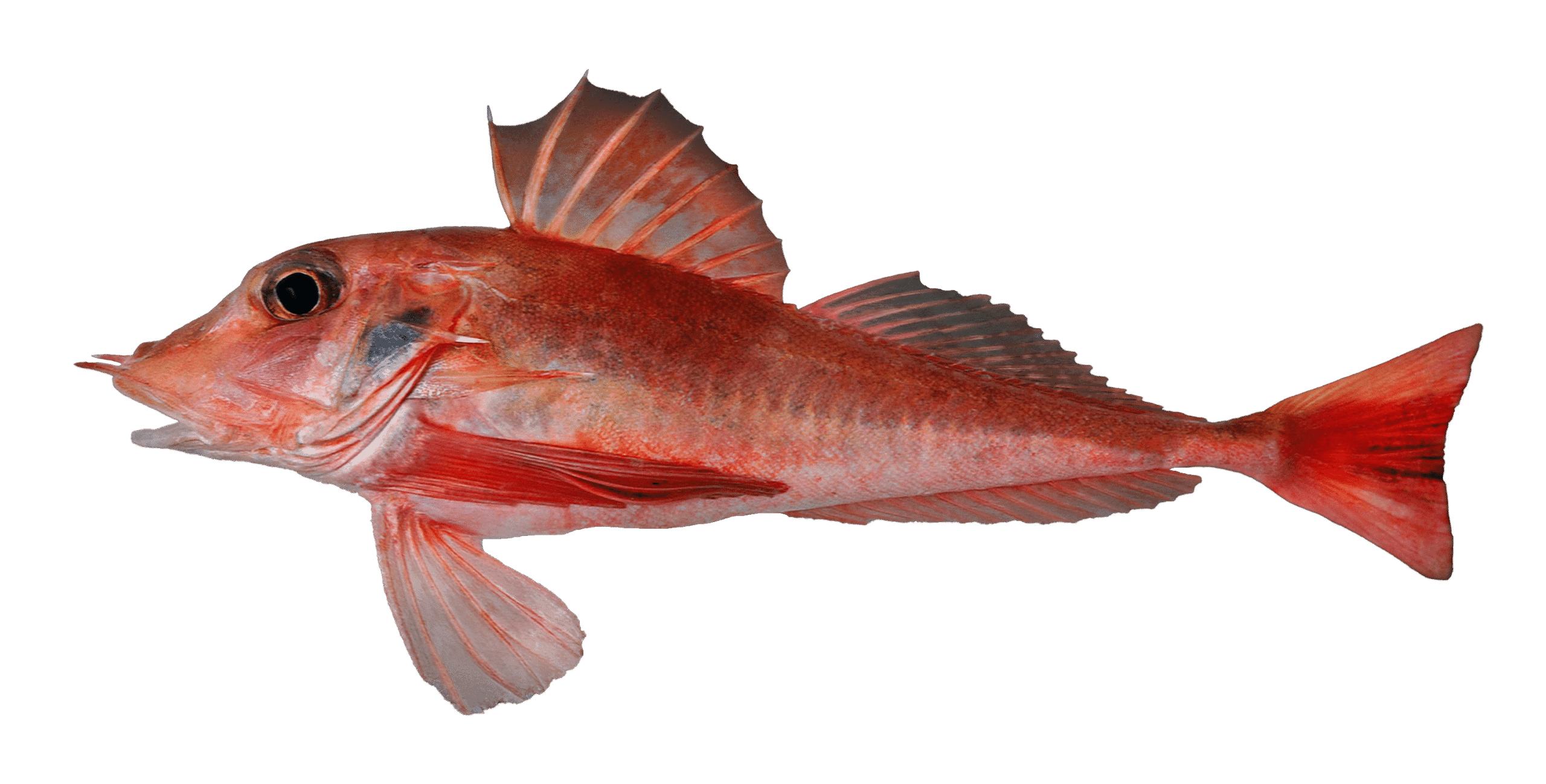
Like all gobies, it has a massive head protected by bony plates. Its most striking feature is its rostrum (snout), which is divided into two flat, serrated points, forming a sort of fork that protrudes forward. These points are broad and colorful. The first three rays of these fins are free, thick, and jointed, resembling fingers that the fish uses to walk along the bottom and detect its prey. The body is a bright, vivid red on the back and sides, fading to white on the belly. The pectoral fins may have bluish highlights along the edges. Its average size is 30 cm, but it can reach a maximum length of 60 cm.
Habitat
It is a demersal fish found in temperate and tropical waters. It lives primarily on muddy or sandy-mud bottoms of the continental shelf and upper slope. It is generally found between 100 and 400 meters, but can be encountered at depths ranging from 10 meters to 700 meters. It is a predator that sifts through the sediment using its sensory fin rays to flush out small crustaceans, worms, and mollusks.
Distribution
It is common throughout the Mediterranean basin, particularly in areas where the continental shelf is wide, as well as in the Bay of Biscay. It is found from the coasts of Scotland and the southern North Sea to Namibia, including the Canary Islands and Madeira.