Fish
Long-finned gurnard
Chelidonichthys obscura
Out of season
—
Fishing zones
Wild
Origin
18 cm
Minimum size
Description
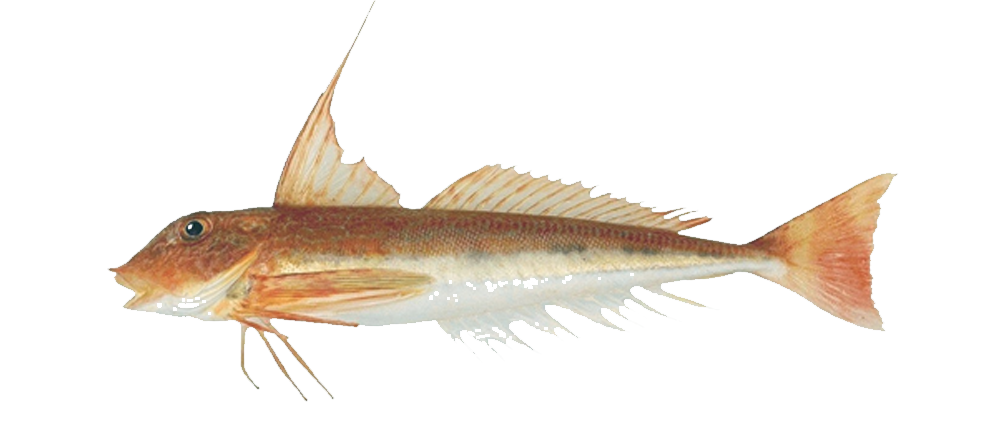
Like all gobies, it has a massive head protected by bony plates. Its snout is short and ends in two small, serrated lobes. This is its most fascinating feature. The first three rays of its pectoral fins are free, jointed, and end in sensory organs. They resemble legs that allow it to walk along the seafloor and detect its prey (crustaceans and mollusks) hidden in the sediment. The second spine of the first dorsal fin is very elongated, clearly extending beyond the other rays, which gives it its English name (Long-finned). The back is bright red or reddish-pink, while the sides are lighter and the belly whitish. Its pectoral fins are often edged with blue or purple. Its maximum length is about 34 cm, but the average is around 20 cm.
Habitat
It is a demersal fish that lives on the seafloor. It prefers soft substrates, mainly sand, mud, or fine gravel, where it can use its free rays to sift through the substrate. It is generally found at depths between 10 and 170 meters. It is capable of producing sounds (grunts) by vibrating its swim bladder using specific muscles, often when it is stressed or during the breeding season.
Distribution
It is very common throughout the Mediterranean basin and the Adriatic Sea. However, it is rare in the Black Sea and absent from the Baltic Sea. Its range extends from the southern British Isles and the English Channel to Mauritania in the south, including the Azores, Madeira, and the Canary Islands.