Fish
Comber
Serranus cabrilla
Out of season
—
Fishing zones
Wild
Origin
15 cm
Minimum size
Description
Until the end of May.
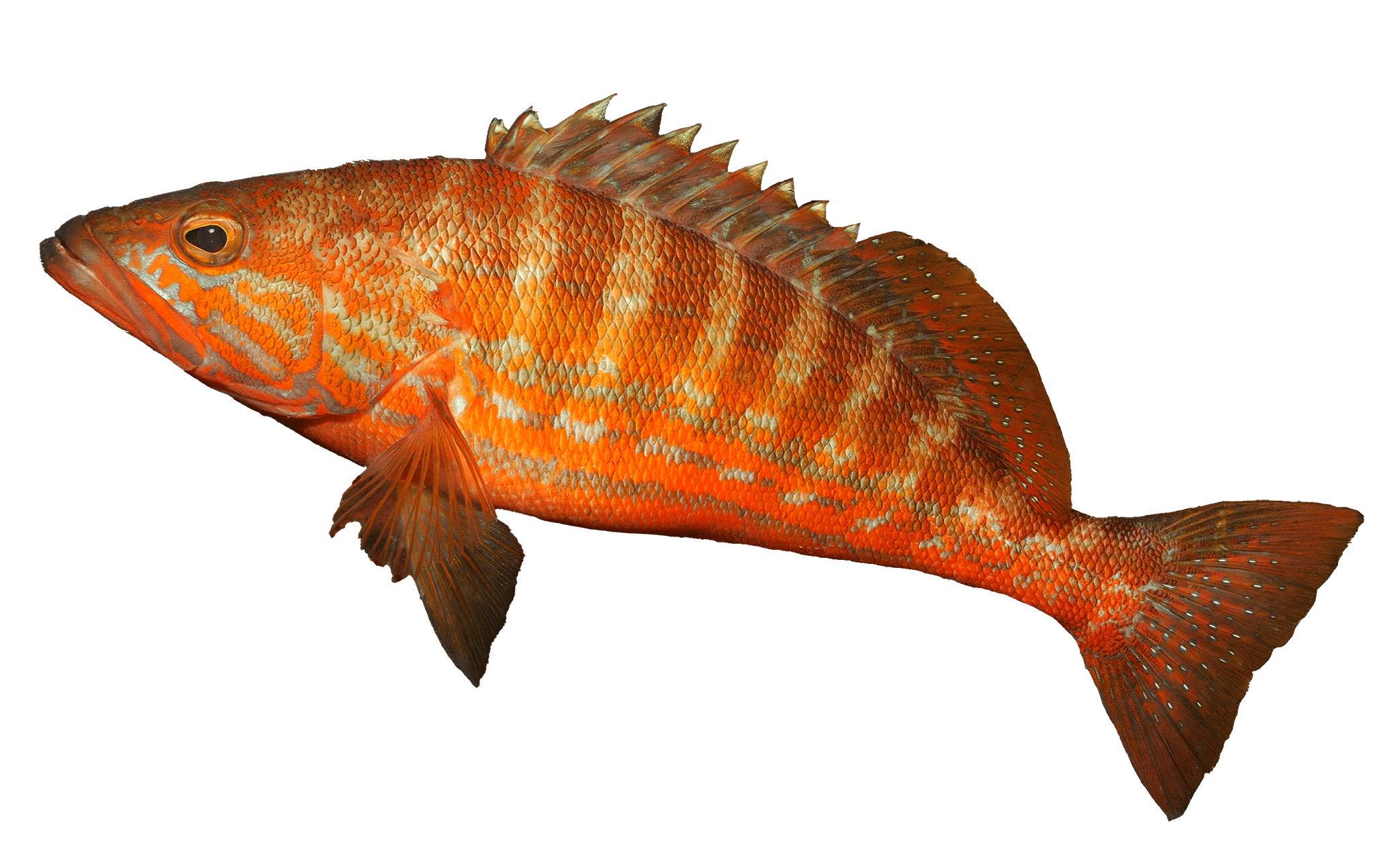
The body is elongated and slightly compressed laterally, with a pointed snout. Its coloration is very distinctive. It has a yellowish to reddish base color, with 7 to 9 dark vertical bars on the flanks. It also has 2 or 3 orange or yellowish longitudinal lines running along the body, sometimes crossing the vertical bars. The dorsal fin is single and continuous, with a well-developed spiny portion (10 spines). Its typical size ranges from 15 to 25 cm, but it can reach a maximum length of 40 cm. It is a synchronous hermaphrodite, meaning that an individual possesses functional male and female reproductive organs at the same time. It is a voracious predator that feeds on small fish, crustaceans, and mollusks.
The body is elongated and slightly compressed laterally, with a pointed snout. Its coloration is very distinctive. It has a yellowish to reddish base color, with 7 to 9 dark vertical bars on the flanks. It also has 2 or 3 orange or yellowish longitudinal lines running along the body, sometimes crossing the vertical bars. The dorsal fin is single and continuous, with a well-developed spiny portion (10 spines). Its typical size ranges from 15 to 25 cm, but it can reach a maximum length of 40 cm. It is a synchronous hermaphrodite, meaning that an individual possesses functional male and female reproductive organs at the same time. It is a voracious predator that feeds on small fish, crustaceans, and mollusks.
Habitat
A marine, benthic, and sedentary species. It is found at a wide range of depths, from 0 to 500 meters, but is most common on the continental shelf between 10 and 150 meters. It prefers rocky bottoms, Posidonia (Posidonia oceanica) seagrass beds, as well as sandy and gravelly bottoms near reefs. It is a curious fish that does not burrow but hides in crevices.
Distribution
Its range is mainly concentrated in the eastern Atlantic and its adjacent seas. From the southern English Channel (sometimes as far south as the British Isles) to South Africa. It is very common throughout the Mediterranean Sea and found in the western Black Sea. It is found around the Azores, Madeira, and the Canary Islands. It has also been reported in the southwestern Indian Ocean.