Fish
Bluefish
Pomatomus saltatrix
Out of season
—
Fishing zones
Wild
Origin
22 cm
Minimum size
Description
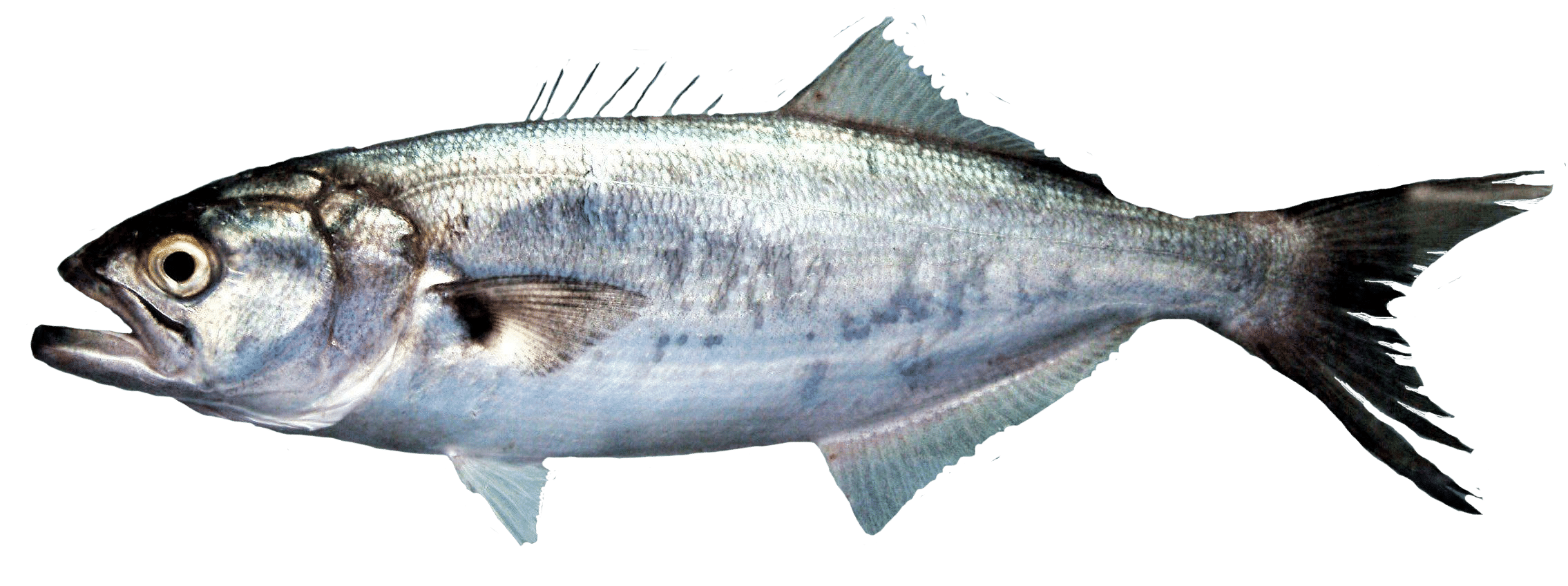
The blue marlin has a spindle-shaped body that is elongated and laterally compressed, typical of large pelagic swimmers. Its head is massive with a wide, oblique mouth. The lower jaw is slightly protruding and armed with very sharp, triangular teeth that are as sharp as razors. The back is blue-green or gray-green, the sides are silvery, and the belly is white. A dark spot is often visible at the base of the pectoral fin. It has two dorsal fins: the first is short with fragile spines, the second is long and symmetrical to the anal fin. The tail (caudal fin) is forked, a sign of its speed. On average between 20 and 60 cm, but it can reach an exceptional maximum size of 130 cm and weigh about 14 kg. Known for its aggressiveness, it hunts in organized schools. It preys on a wide variety of fish (mullet, sardines, anchovies). It is famous for "bluefish blitzes", where schools drive fish toward the surface in a feeding frenzy.
Habitat
A marine and coastal-pelagic species. It generally inhabits waters ranging from the surface to a depth of 200 meters, above the continental shelf. It is often found in surf zones, estuaries, and bays, especially during the summer months when it moves closer to the coast to hunt. Juveniles are more common in estuaries and coves. It prefers temperate to subtropical waters (between 14°C and 25°C).
Distribution
The bluefin trevally has a cosmopolitan distribution (found everywhere except in the North Pacific and the eastern Pacific). From Canada to Argentina, from Portugal to South Africa, including around islands such as the Azores and Madeira. Found throughout the basin, with a marked abundance in the eastern Mediterranean. Found off the coasts of South Africa, Australia, and New Zealand.