Fish
Poisson
Axillary seabream
Pagellus acarne
Out of season
—
Fishing zones
Wild
Origin
18 cm
Minimum size
Description
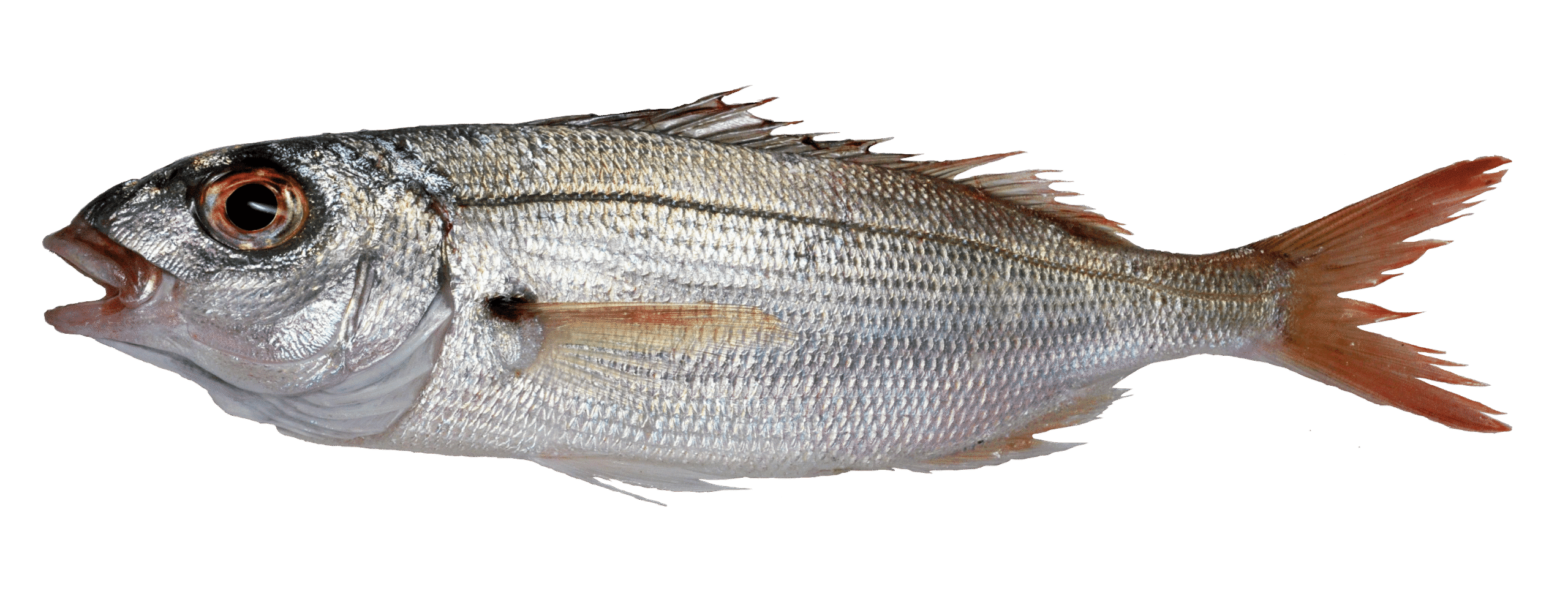
The body is spindle-shaped (slender) and moderately compressed from side to side. The profile of the head is fairly straight, with a slightly pointed muzzle. Its coloration ranges from pinkish-gray to silvery, with darker hues on the back and a lighter belly. It has a black or very dark red spot at the base (axilla) of the pectoral fin, which makes it easily distinguishable from other sculpin species. It generally measures between 25 and 30 cm, but can reach a maximum size of 36 cm. It is a protandric hermaphrodite (it is born male and becomes female as it matures, usually between 2 and 7 years of age). It is omnivorous with a strong carnivorous preference. It feeds mainly on small invertebrates (worms, mollusks, small crustaceans) and occasionally on fish larvae.
Habitat
A demersal (bottom-dwelling) to semi-pelagic species. It is found at depths ranging from 0 to 500 meters, but is much more common on the continental shelf between 40 and 100 meters. It inhabits various types of substrates, including sandy and muddy bottoms, rocky areas, and Posidonia seagrass beds. Adults often live in sparse schools or alone, while juveniles remain closer to the coast, in shallower waters.
Distribution
The species is widely distributed throughout the eastern Atlantic and the Mediterranean. From the Bay of Biscay to Senegal and Cape Verde (rare further north, although occasionally sighted as far north as Denmark). Found in the Azores, Madeira, and the Canary Islands. Common throughout the Mediterranean basin, including the Sea of Marmara and the southern Black Sea.