Fish
Poisson
Atlantic halibut
Hippoglossus hippoglossus
Out of season
—
Fishing zones
Wild
Origin
135 cm
Minimum size
Description
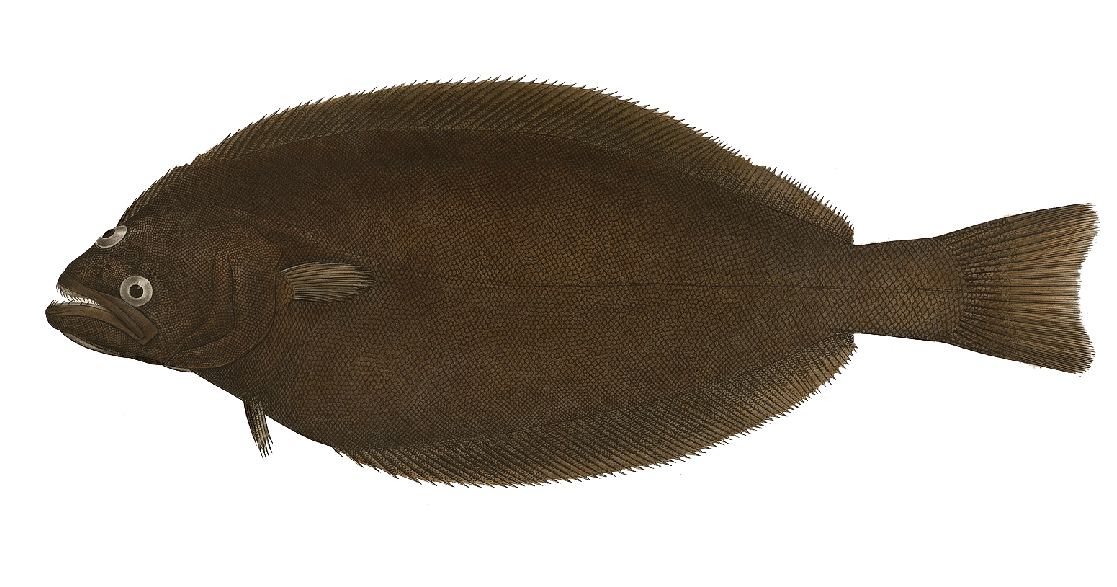
It is a flatfish with an elongated, oval shape (thicker than a sole or a turbot). Its mouth is very wide and lined with sharp teeth, revealing its role as a top predator. Like most halibuts, it is a right-eyed fish (both eyes are located on the right side of the body). Its tail is concave (crescent-shaped or very flared "V" shaped), allowing it to swim quickly in open water to hunt. The eye side (top) is uniform in color, ranging from dark gray to chocolate brown or black. The blind side (underside) is pure white. It is the largest flatfish in the world. It can reach a record size of 4.7 meters and weigh 320 kg, although specimens caught typically measure between 1 and 2 meters.
Habitat
It is a demersal fish (living near the bottom) but does not hesitate to swim up into the open water to chase its prey. It prefers sandy, gravelly, or rocky bottoms, avoiding areas with soft mud. It thrives in cold waters, generally between 3°C and 9°C. It is found at a wide range of depths, from 50 meters to 2,000 meters.
Distribution
It is found exclusively in the North Atlantic (boreal and subarctic waters). From Greenland and Labrador (Canada) to New Jersey (United States). From Spitsbergen and the Barents Sea to the Bay of Biscay in the south (where it becomes very rare). Very common around Iceland, Norway, Scotland, and in the northern North Sea.