Sea plant
Annual sea-blite
Suaeda maritima
Out of season
—
Fishing zones
Wild
Origin
—
Minimum size
Description
In accordance with the regulations in force.
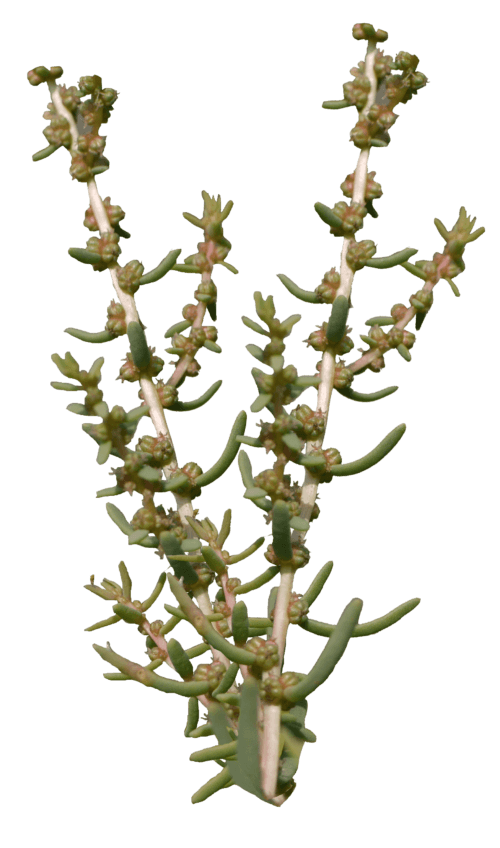
It is a small herbaceous annual plant (therophyte) in the Amaranthaceae family. It typically grows to between 10 and 50 cm in height. Its leaves are fleshy, succulent, linear, and semi-cylindrical in shape. They are glaucous green (blue-green) but often turn red or purple in late summer or in high-salinity conditions. Flowers: Very inconspicuous and greenish in color, they are grouped in clusters of 2 or 3 in the leaf axils. Flowering occurs from July to October. The young shoots are edible. They have a naturally salty taste and can be eaten raw in salads or cooked like spinach. They are sometimes used as a condiment (similar to glasswort).
It is a small herbaceous annual plant (therophyte) in the Amaranthaceae family. It typically grows to between 10 and 50 cm in height. Its leaves are fleshy, succulent, linear, and semi-cylindrical in shape. They are glaucous green (blue-green) but often turn red or purple in late summer or in high-salinity conditions. Flowers: Very inconspicuous and greenish in color, they are grouped in clusters of 2 or 3 in the leaf axils. Flowering occurs from July to October. The young shoots are edible. They have a naturally salty taste and can be eaten raw in salads or cooked like spinach. They are sometimes used as a condiment (similar to glasswort).
Habitat
It is a halophilic plant (one that thrives in salty environments). It is found exclusively in coastal areas subject to tidal influence. It colonizes salt marshes (slikkas and schorres), tidal flats, and the edges of salt marshes. It is often considered a pioneer species, capable of establishing itself on highly unstable, salt-saturated soils. Mainly in the intertidal zone, often just below the high-tide line.
Distribution
Suaeda maritima is found almost worldwide (cosmopolitan) along temperate coasts. It is very common along the entire coastline of the English Channel, the Atlantic, and the Mediterranean (including Corsica). It is found on the northeastern coasts (Canada and the United States). It is also found along Asian coasts and in certain regions of the Southern Hemisphere.