Fish
Poisson
Golden grey mullet
Liza aurata
(GSA7) Gulf of Lion, (GSA8) Corsica
Fishing zones
Wild
Origin
21 cm
Minimum size
Description
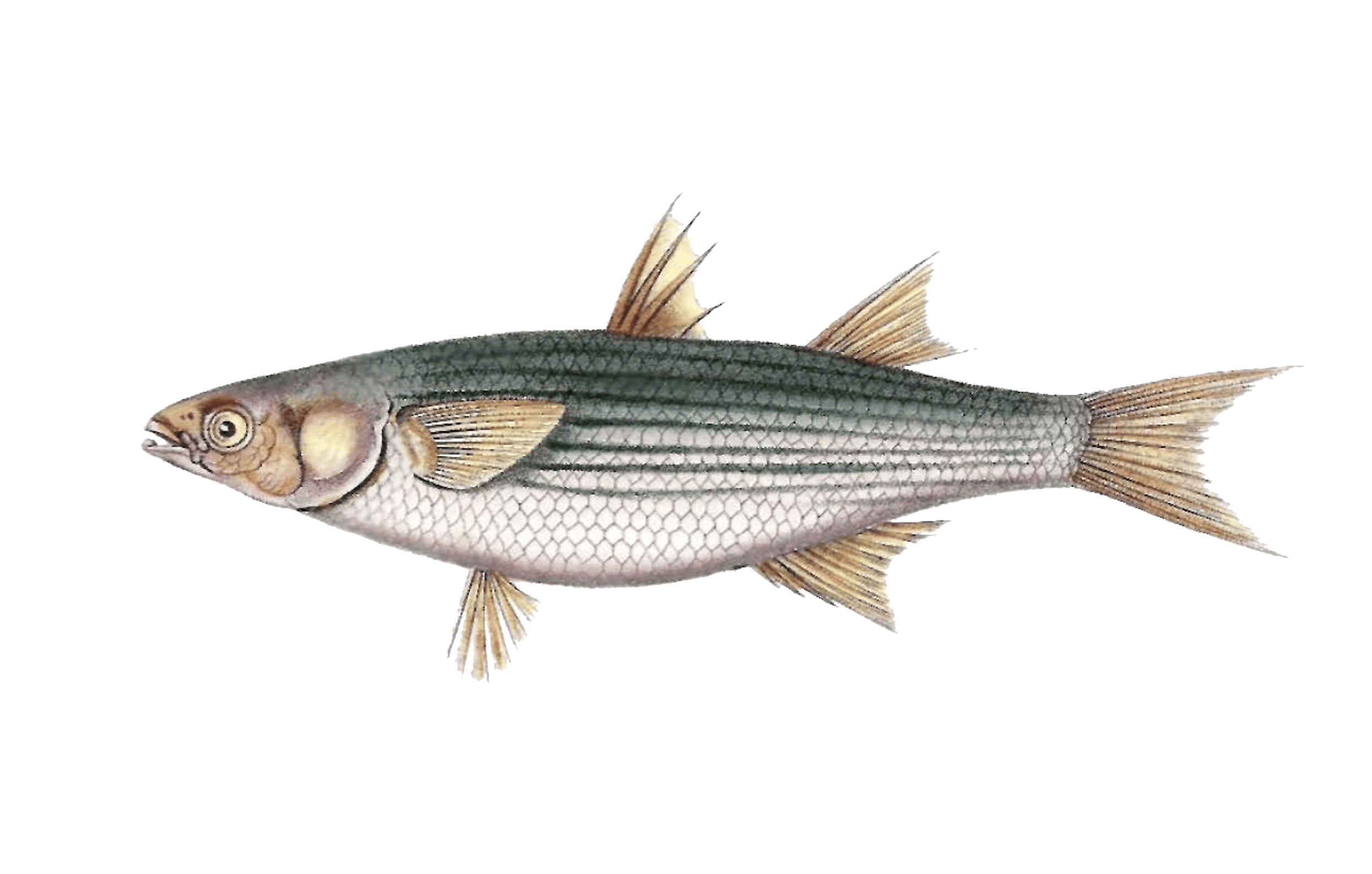
Key distinguishing feature: A clearly visible golden spot on the operculum (cheek), which gives it its name. Spindle-shaped and elongated, with an almost cylindrical cross-section and a massive, flattened head above the eyes, its back is dark gray with a bluish tint, its sides are silvery with several more or less distinct gray longitudinal lines, and its belly is silvery-white. Its pectoral fins are fairly long and lack a black spot at their base (unlike the black mullet). It measures an average of 30 cm, but can reach a maximum length of 60 cm and weigh up to 2.5 kg. Adults feed on small benthic organisms, organic detritus, and occasionally insects and plankton. Juveniles feed exclusively on zooplankton.
Habitat
A pelagic-neritic species (coastal waters). It is euryhaline, meaning it can tolerate wide variations in salinity. It often lives in schools. It is found along rocky or sandy coasts, in harbors, coastal lagoons, and lower estuaries. It is generally found at depths of 1 to 20 meters. Unlike other mullets (such as the pig mullet), the golden mullet rarely ventures into strictly freshwater (rivers), preferring to remain in brackish or marine areas.
Distribution
The species is widely distributed throughout the eastern Atlantic. In the north, it is found from the British Isles and southern Norway to the North Sea. In the south, it extends along the Bay of Biscay to the coasts of West Africa (Senegal) and the islands (Canary Islands, Azores, Madeira). In inland seas, it is very abundant throughout the Mediterranean Sea and the Black Sea. It has also been successfully introduced into the Caspian Sea.