Fish
Spanish mackerel
Scomber colias
Out of season
—
Fishing zones
Wild
Origin
21 cm
Minimum size
Description
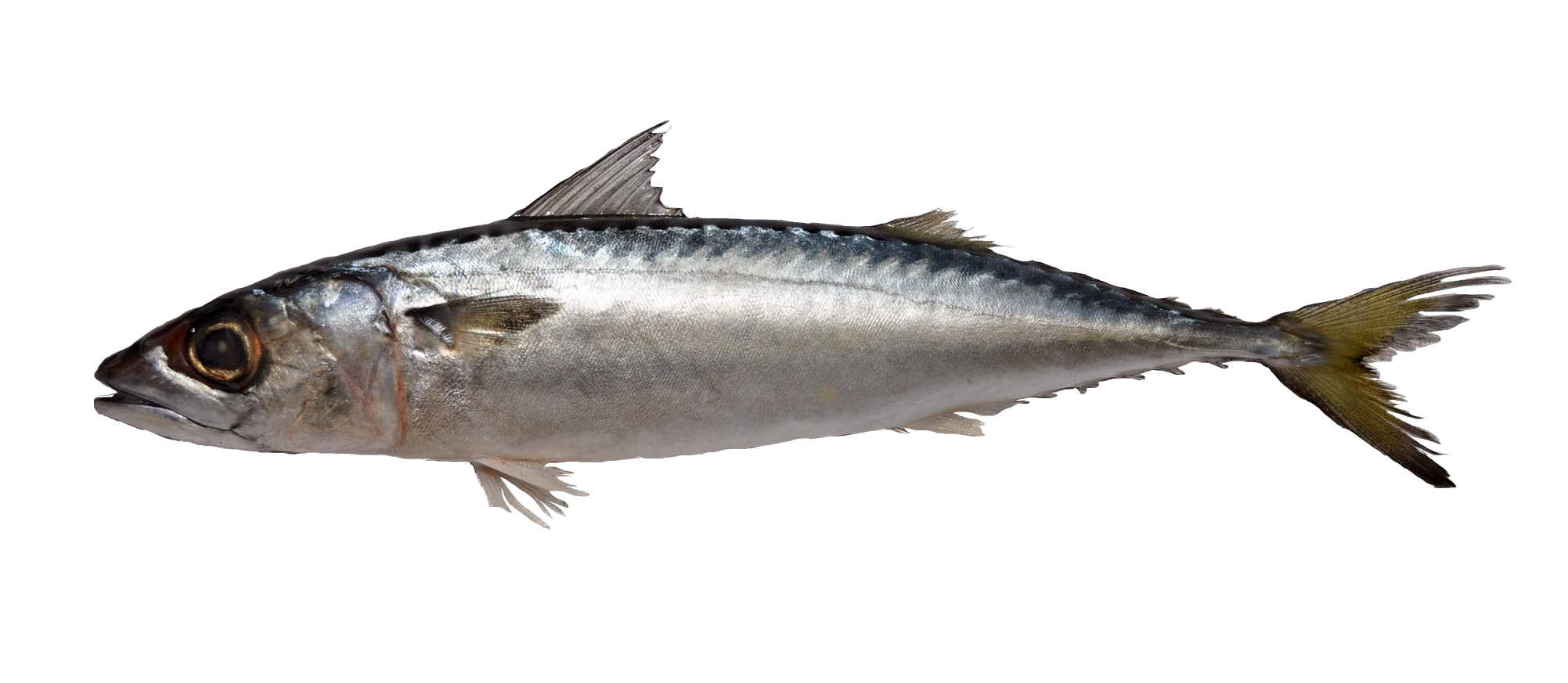
is a pelagic marine fish of the Scombridae family. It has a spindle-shaped body, slightly stockier than that of Scomber scombrus, and swims rapidly and continuously.
The back is bluish-green with oblique wavy lines, while the belly is silvery and dotted with dark spots or sinuous lines.
It has two separate dorsal fins and a series of finlets in front of the caudal fin, typical of mackerels.
The back is bluish-green with oblique wavy lines, while the belly is silvery and dotted with dark spots or sinuous lines.
It has two separate dorsal fins and a series of finlets in front of the caudal fin, typical of mackerels.
Habitat
This is a pelagic-neritic marine species, occasionally observed in brackish waters.
It inhabits the water column from the surface down to about 300 m, above the continental shelf and occasionally on the continental slope.
The species is adapted to temperate to warm temperate waters and undertakes seasonal migrations related to temperature and reproduction.
Primary habitat: neritic and epipelagic zones
Depth: surface to 300 m
Preferred temperature: temperate waters
It inhabits the water column from the surface down to about 300 m, above the continental shelf and occasionally on the continental slope.
The species is adapted to temperate to warm temperate waters and undertakes seasonal migrations related to temperature and reproduction.
Primary habitat: neritic and epipelagic zones
Depth: surface to 300 m
Preferred temperature: temperate waters
Distribution
It is found in the eastern and western Atlantic, the Mediterranean, and the southern part of the Black Sea.
Its range extends approximately from 46°N to 65°S.
In the Indo-Pacific, the species is absent and is replaced by Scomber japonicus, which explains the frequent confusion between the two species.
Its range extends approximately from 46°N to 65°S.
In the Indo-Pacific, the species is absent and is replaced by Scomber japonicus, which explains the frequent confusion between the two species.