Crustacean
Mediterranean green crab
Carcinus aestuarii
Out of season
—
Fishing zones
Wild
Origin
10 cm
Minimum size
Description
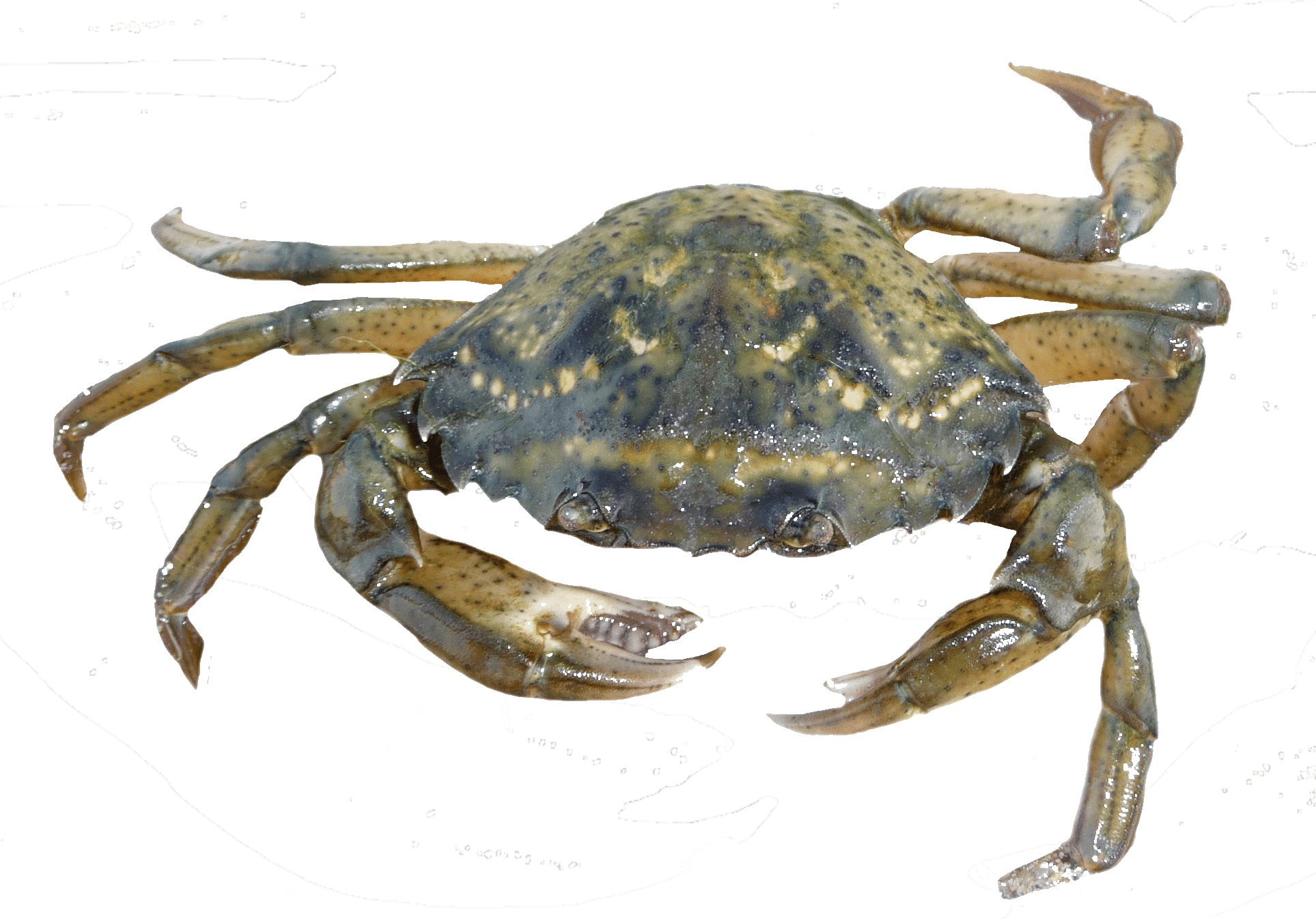
Its carapace is trapezoidal in shape, slightly wider than it is long. The edge of the carapace between the eyes is smooth (unlike the Atlantic green crab, which has three rounded lobes). It has five sharp spines on either side of the eyes. Its claws are robust and slightly uneven in size. Its walking legs are fairly long and slender. Unlike the blue crab, it does not have paddle-shaped legs; it is a walking crab and not a deep-water swimmer. Its color is highly variable, ranging from dark green to gray-brown on the back, while the underside can be yellow, orange, or even red in adult males during molting. The width of the carapace is generally between 4 and 6 cm, though it can exceptionally reach 8 cm.
Habitat
This is a highly resilient coastal species that thrives in calm waters. It is found in abundance in lagoons, brackish ponds, estuaries, and harbors. It lives primarily on sandy or muddy bottoms, or among rocks and beds of Posidonia or eelgrass. It is extremely tolerant of variations in temperature and salinity, as well as organic pollution, which allows it to survive in environments where other species disappear. It lives in the intertidal zone (which is very limited in the Mediterranean) and at depths of up to about 10 to 20 meters.
Distribution
It is native to the Mediterranean Sea, the Black Sea, and the Sea of Azov. It can be found in isolated populations along the Atlantic coasts of Morocco and the Iberian Peninsula, where it may coexist with Carcinus maenas (the Atlantic green crab).