Fish
Poisson
Atlantic bluefin tuna
Thunnus thynnus
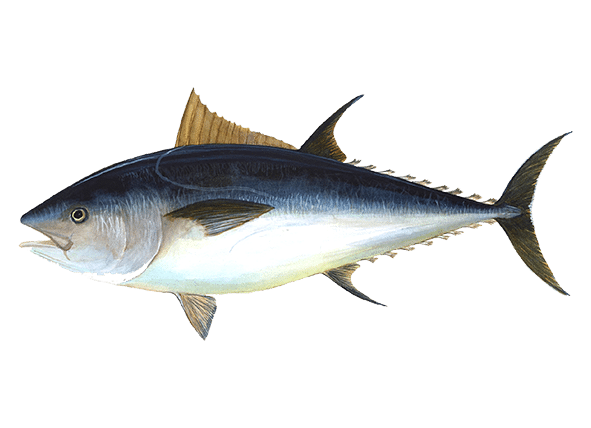
(FAO 27) Northeast Atlantic, FAO 37 - Mediterranean and Black Sea
Fishing zones
Wild
Origin
120 cm
Minimum size
Description
Large, massive, and spindle-shaped, built for speed. It is one of the largest bony fish. The back is dark blue to black, the sides are silvery with colorless spots, and the belly is milky white. The finlets located behind the dorsal and anal fins are bright yellow with black edges. The first dorsal fin is yellow or bluish; the second is taller and reddish-brown in color. The pectoral fins are very short in this species compared to other tunas (they do not extend beyond the base of the second dorsal fin). The typical size is around 2 meters. A voracious and swift predator. It feeds on schooling fish (herring, anchovies, sardines, mackerel), squid, and crustaceans.
Habitat
A pelagic species (living in the open sea) and an oceanodrome (capable of long-distance migration). It typically inhabits waters ranging from the surface down to a depth of 1,000 meters. This species is capable of regulating its body temperature (partial endothermy), which allows it to venture into very cold waters to hunt while maintaining an active metabolism.
Distribution
Its range covers mainly the North Atlantic and its adjacent seas. From Canada and Newfoundland to the Gulf of Mexico and the Caribbean Sea; also off the coast of Brazil. From Norway to the Canary Islands, including the North Sea. It is very common throughout the Mediterranean Sea and, historically, was found in the Black Sea (where it has become rare today).